Strange doings daw0050 v.., p.1
Strange Doings DAW0050 (v1.0), page 1


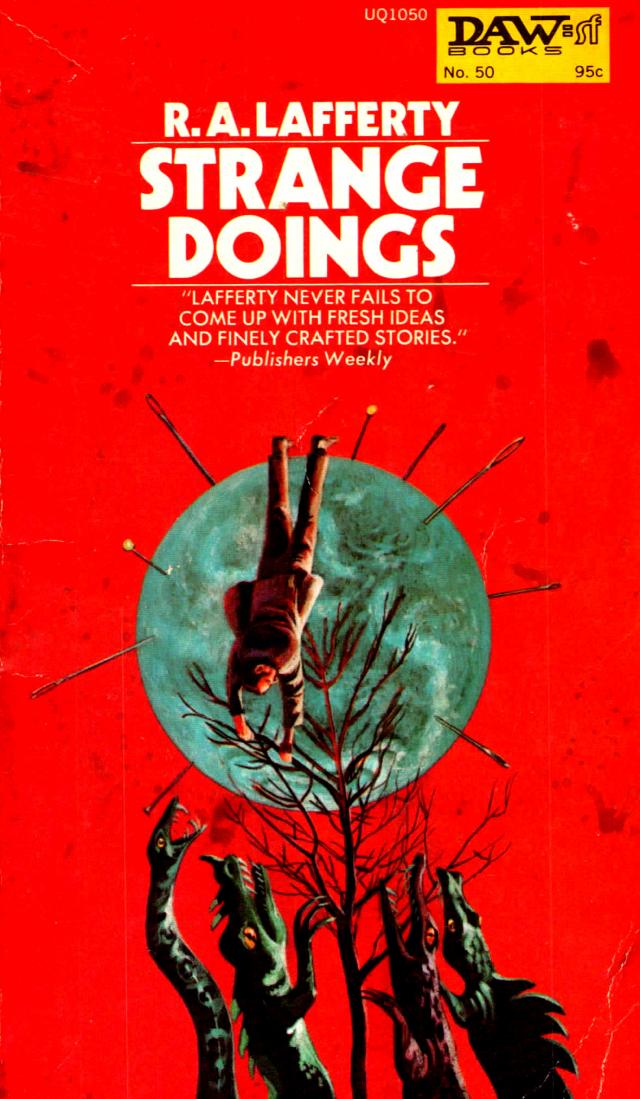
FROM BIZARRE HUMOR
TO SHEER HORROR,
the sixteen stories in this surprising hook cover the entire range of fantasy. All are offbeat with the wry, playful, unboundaried imagination that has gained R. A. Lafferty a steadily increasing following of delighted readers.
Stories such as World Abounding, The Man with the Speckled Eyes, Entire and Perfect Chrysolite, Cliffs That Laughed, and the Hugo-contending Continued on Next Rock, reveal Lafferty penetrating to the zany realities of the human and inhuman condition.
You will move through strange worlds of personality literally splitting itself, of nightmares becoming true and preferred, of the perils of doubting and the hazards of believing. And in each story you will move through the individual and beautiful styles of a master of the unexpected turn of phrase, idea and situation.
Strange
Doings
R. A. LAFFERTY
Illustrated by JACK GAUGHAN
Copyright, ©, 1972, by R. A. Lafferty
A DAW Book, by arrangement with
Charles Scribner’s Sons.
ALL RIGHTS RESERVED.
COVER ART BY JACK GAUGHAN
The following stories were first published in the magazines indicated below:
Galaxy: “All But the Words,”
“Aloys,” “Dreamworld,”
“Rainbird,”
“Sodom and Gomorrah, Texas.”
Copyright © 1971 UPD Corporation. Copyright © 1961,
1962 Galaxy Publishing Corporation.
If: “Ride a Tin Can.”
Copyright © 1970 UPD Corporation.
The Literary Review: “The Ugly Sea.”
Copyright © 1961 Fairledgh Dickinson University.
The Magazine of Fantasy and Science Fiction: “Camels and
Dromedaries, Clem,”
“The Man with the Speckled Eyes,”
“World Abounding.”
Copyright © 1967 1964, 1971 Mercury Press, Inc.
The Magazine of Horror: “Cliffs That Laughed.”
Copyright © 1968 Health Knowledge, Inc.
Orbit (6, 7): “Entire and Perfect Chrysolite,”
“Continued on Next Rock.”
Copyright © 1970 Damon Knight
Quark 2: “Incased in Ancient Rind.”
Copyright © 1971 Coronet Communications, Inc.
Worlds of Tomorrow: “The Transcendent Tigers.”
Copyright © 1964 Galaxy Publishing Corporation.
FIRST PRINTING, APRIL 1973
2 3 4 5 6 7 8 9
PRINTED IN U.S.A
Contents:-
Rainbird
Camels and Dromedaries, Clem
Continued on Next Rock
Once on Aranea
Sodom and Gomorrah, Texas
The Man with the Speckled Eyes
All but the Words
The Transcendent Tigers
World Abounding
Dream
Ride a Tin Can
Aloys
Entire and Perfect Chrysolite
Incased in Ancient Rind
The Ugly Sea
Cliffs that Laughed
Rainbird
Were scientific firsts truly tabulated the name of the Yankee inventor, Higgston Rainbird, would surely be without peer. Yet today he is known (and only to a few specialists, at that) for an improved blacksmith’s bellows in the year 1785, for a certain modification (not fundamental) in the moldboard plow about 1805, for a better (but not good) method of reefing the lanteen sail, for a chestnut roaster, for the Devil’s Claw Wedge for splitting logs, and for a nutmeg grater embodying a new safety feature; this last was either in the year 1816 or 1817. He is known for such, and for no more.
Were this all that he achieved his name would still be secure. And it is secure, in a limited way, to those who hobby in technological history.
But the glory of which history has cheated him, or of which he cheated himself, is otherwise. In a different sense it is without parallel, absolutely unique.
For he pioneered the dynamo, the steam automobile, the steel industry, ferro-concrete construction, the internal combustion engine, electric illumination and power, the wireless, the televox, the petroleum and petrochemical industries, monorail transportation, air travel, worldwide monitoring, fissionable power, space travel, group telepathy, political and economic balance; he built a retrogressor; and he made great advances towards corporal immortality and the apotheosis of mankind. It would seem unfair that all this is unknown of him.
Even the once solid facts—that he wired Philadelphia for light and power in 1799, Boston the following year, and New York two years later—are no longer solid. In a sense they are no longer facts.
For all this there must be an explanation; and if not that, then an account at least; and if not that, well—something anyhow.
Higgston Rainbird made a certain decision on a June afternoon in 1779 when he was quite a young man, and by this decision he confirmed his inventive bent.
He was hawking from the top of Devil’s Head Mountain. He flew his falcon (actually a tercel hawk) down through the white clouds, and to him it was the highest sport in the world. The bird came back, climbing the blue air, and brought a passenger pigeon from below the clouds. And Higgston was almost perfectly happy as he hooded the hawk.
He could stay there all day and hawk from above the clouds. Or he could go down the mountain and work on his sparker in his shed. He sighed as he made the decision, for no man can have everything. There was a fascination about hawking. But there was also a fascination about the copper-strip sparker. And he went down the mountain to work on it.
Thereafter he hawked less. After several years he was forced to give it up altogether. He had chosen his life, the dedicated career of an inventor, and he stayed with it for sixty-five years.
His sparker was not a success. It would be expensive, its spark was uncertain and it had almost no advantage over flint. People could always start a fire. If not, they could borrow a brand from a neighbor. There was no market for the sparker. But it was a nice machine, hammered copper strips wrapped around iron teased with lodestone, and the thing turned with a hand crank. He never gave it up entirely. He based other things upon it; and the retrogressor of his last years could not have been built without it.
But the main thing was steam, iron, and tools. He made the finest lathes. He revolutionized smelting and mining. He brought new things to power, and started the smoke to rolling. He made mistakes, he ran into dead ends, he wasted whole decades. But one man can .only do so much.
He married a shrew, Audrey, knowing that a man cannot achieve without a goad as well as a goal. But he was without issue or disciple, and this worried him.
He built a steamboat and a steam train. His was the first steam thresher. He cleared the forests with wood-burning giants, and designed towns. He destroyed southern slavery with a steam-powered cotton picker, and power and wealth followed him.
For better or worse he brought the country up a long road, so there was hardly a custom of his boyhood that still continued. Probably no one man had ever changed a country so much in his lifetime.
He fathered a true machine-tool industry, and brought rubber from the tropics and plastic from the laboratory. He pumped petroleum, and used natural gas for illumination and steam power. He was honored and enriched; and, looking back, he had no reason to regard his life as wasted.
“Yes, I’ve missed so much. I wasted a lot of time. If only I could have avoided the blind alleys, I could have done many times as much. I brought machine tooling to its apex. But I neglected the finest tool of all, the mind. I used it as it is, but I had not time to study it, much less modify it. Others after me will do it all. But I rather wanted to do it all myself. Now it is too late.”
He went back and worked on his old sparker and its descendents, now that he was old. He built toys along the line of it that need not always have remained toys. He made a televox, but the only practical application was that now Audrey could rail at him over a greater distance. He fired up a little steam dynamo in his house, ran wires and made it burn lights in his bam.
And he built a retrogressor.
“I would do much more along this line had I the time. But I’m pepper-bellied pretty near the end of the road. It is like finally coming to a gate and seeing a whole greater world beyond it, and being too old and feeble to enter.”
He kicked a chair and broke it.
“I never even made a better chair. Never got around to it. There are so clod-hopping many things I meant to do. I have maybe pushed the country ahead a couple of decades faster than it would otherwise have gone. But what couldn’t I have done if it weren’t for the blind alleys! Ten years lost in one of them, twelve in another. If only there had been a way to tell the true from the false, and to leave to others what they could do, and to do myself only what nobody else could do. To see a link (however unlikely) and to go out and get it and set it in its place. Oh, the waste, the wilderness that a talent can wander in! If I had only had a mentor! If I had had a map, a clue, a hatful of clues. I was bom shrewd, and I shrewdly cut a path and went a grand ways. But always there was a clearer .path and a faster way that I did not see till later. As my name is Rainbird, if I had it to do over, I’d do it infinitely better.”
He began to write a list of the things that he’d have done better. Then he stopped and threw away his pen in disgust.
“Never did even invent a decent ink pen.
He poured himself a jolt, but he made a face as he drank it.
“Never got around to distilling a really better whiskey.
Had some good ideas along that line, too. So many things I never did do. Well, I can’t improve things by talking to myself here about it.”
Then he sat and thought.
“But I burr-tailed can improve things by talking to myself there about it.”
He turned on his retrogressor, and went back sixty-five years and up two thousand feet.
Higgston Rainbird was hawking from the top of Devil’s Head Mountain one June afternoon in 1779. He flew his bird down through the white fleece clouds, and to him it was sport indeed. Then it came back, climbing the shimmering air, and brought a pigeon to him.
“It’s fun,” said the old man, “but the bird is tough, and you have a lot to do. Sit down and listen, Higgston.”
“How do you know the bird is tough? Who are you, and how did an old man like you climb up here without my seeing you? And how in hellpepper did you know that my name was Higgston?”
“I ate the bird and I remember that it was tough. I am just an old man who would tell you a few things to avoid in your life, and I came up here by means of an invention of my own. And I know your name is Higgston, as it is also my name; you being named after me, or I after you, I forget which. Which one of us is the older, anyhow?”
“I had thought that you were, old man. I am a little interested in inventions myself. How does the one that carried you up here work?”
“It begins, well it begins with something like your sparker, Higgston. And as the years go by you adapt and add. But it is all tinkering with a force field till you are able to warp it a little. Now then, you are an ewer-eared galoot and not as handsome as I remembered you; but I happen to know that you have the makings of a fine man. Listen now as hard as ever you listened in your life. I doubt that I will be able to repeat. I will save you years and decades; I will tell you the best road to take over a journey which it was once said that a man could travel but once. Man, I’ll pave a path for you over the hard places and strew palms before your feet.”
“Talk, you addlepated old gaff. No man ever listened so hard before.”
The old man talked to the young one for five hours. Not a word was wasted; they were neither of them given to wasting words. He told him that steam wasn’t everything, this before he knew that it was anything. It was a giant power, but it was limited. Other powers, perhaps, were not. He instructed him to explore the possibilities of amplification and feedback, and to use always the lightest medium of transmission of power: wire rather than mule-drawn coal cart, air rather than wire, ether rather than air. He warned against time wasted in shoring up the obsolete, and of the bottomless quicksand of cliché, both of word and of thought.
He admonished him not to waste precious months in trying to devise the perfect apple corer; there will never be a perfect apple corer. He begged him not to build a battery bobsled. There would be things far swifter than a bobsled.
Let others make the new hide scrapers and tanning salts. Let others aid the carter and the candle molder and the cooper in their arts. There was need for a better hame, a better horse block, a better stile, a better whetstone. Well, let others fill those needs. If our buttonhooks, our firedogs, our whiffletrees, our bootjacks, our cheese presses are all badly designed and a disgrace, then let someone else remove that disgrace. Let others aid the cordwainer and the cobbler. Let Higgston do only the high work that nobody else would be able to do.
There would come a time when the farrier himself would disappear, as the fletcher had all but disappeared. But new trades would open for a man with an open mind.
Then the old man got specific. He showed young Higgston a design for a lathe dog that would save time. He told him how to draw, rather than hammer wire; and advised him of the virtues of mica as insulator before other material should come to hand.
“And here there are some things that you will have to take on faith,” said the old man, “things of which we learn the ‘what’ before we fathom the ‘why’.”
He explained to him the shuttle armature and the self-exciting field, and commutation; and the possibilities that alternation carried to its ultimate might open up. He told him a bejammed lot of things about a confounded huge variety of subjects.
“And a little mathematics never hurt a practical man,” said the old gaffer. “I was self-taught, and it slowed me down.”
They hunkered down there, and the old man cyphered it all out in the dust on the top of Devil’s Head Mountain. He showed him natural logarithms and rotating vectors and the calculi and such; but he didn’t push it too far, as even a smart boy can learn only so much in a few minutes. He then gave him a little advice on the treatment of Audrey, knowing it would be useless, for the art of living with a shrew is a thing that cannot be explained to another.
“Now hood your hawk and go down the mountain and go to work,” the old man said. And that is what young Higgston Rainbird did.
The career of the Yankee inventor, Higgston Rainbird, was meteoric. The wise men of Greece were little boys to him, the Renaissance giants had only knocked at the door but had not tried the knob. And it was unlocked all the time.
The milestones that Higgston left are breathtaking. He built a short high dam on the flank of Devil’s Head Mountain, and had hydroelectric power for his own shop in that same year (1779). He had an arc light burning in Horse-Head Lighthouse in 1781. He read by true incandescent light in 1783, and lighted his native village, Knobknocker, three years later. He drove a charcoal fueled automobile in 1787, switched to a distillate of whale oil in 1789, and used true rock oil in 1790. His gasoline powered combination reaper-thresher was in commercial production in 1793, the same year that he wired Centerville for light and power. His first diesel locomotive made its trial run in 1796, in which year he also converted one of his earlier coal burning steamships to liquid fuel.
In 1799 he had wired Philadelphia for light and power, a major breakthrough, for the big cities had manfully resisted the innovations. On the night of the turn of the century he unhooded a whole clutch of new things, wireless telegraphy, the televox, radio transmission and reception, motile and audible theatrical reproductions, a machine to transmit the human voice into print, and a method of sterilizing and wrapping meat to permit its indefinite preservation at any temperature.
And in the spring of that new year he first flew a heavier-than-air vehicle.
“He has made all the basic inventions,” said the many-tongued people. “Now there remains only their refinement and proper utilization.”
“Horse hokey,” said Higgston Rainbird. He made a rocket that could carry freight to England in thirteen minutes at seven cents a hundredweight. This was in 1805. He had fissionable power in 1813, and within four years had the price down where it could be used for desalting seawater to the eventual irrigation of five million square miles of remarkably dry land.
He built a Think Machine to work out the problems that he was too busy to solve, and a Prediction Machine to pose him with new problems and new areas of breakthrough.
In 1821, on his birthday, he hit the moon with a marker. He bet a crony that he would be able to go up personally one year later and retrieve it. And he won the bet.
In 1830 he first put on the market his Red Ball Pipe Tobacco, an aromatic and expensive crimp cut made of Martian lichen.
In 1836 he founded the Institute for the Atmospheric Rehabilitation of Venus, for he found that place to be worse than a smokehouse. It was there that he developed that hacking cough that stayed with him till the end of his days.