

Shike, p.1
Shike, page 1


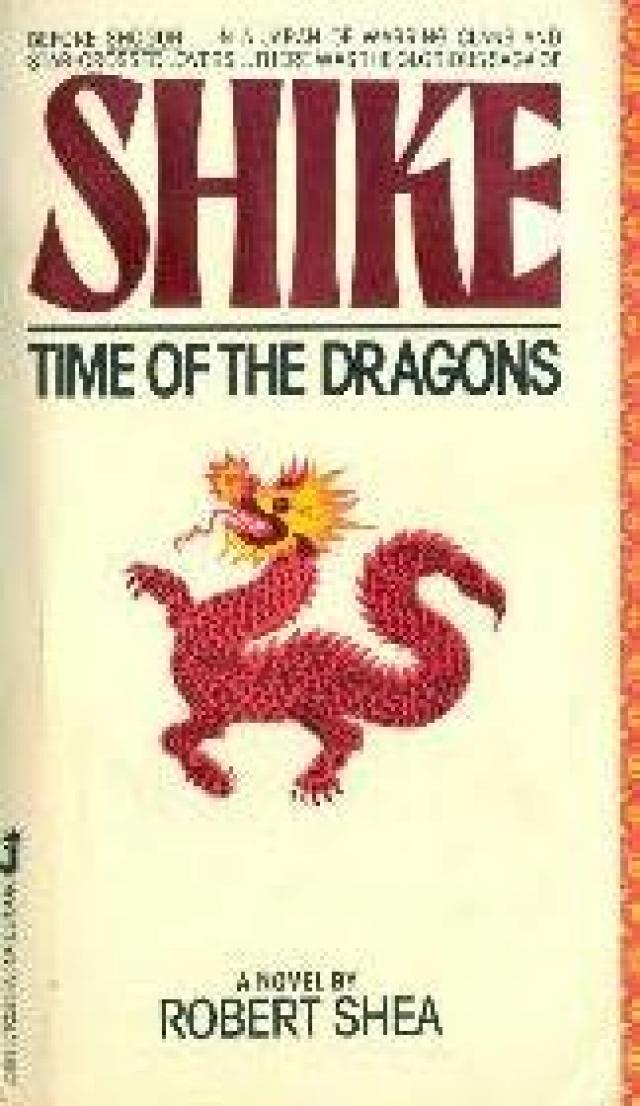
Shike
by Robert J. Shea
Originally published in 1981
Note: This work is released under a Creative Commons Attribution Non-Commercial Share-Alike license. You are free to distribute and modify this work as long as you do so without commercial gain, share the results under this same license, and attribute the original work to Robert J. Shea.
Due to errors in scanning and digitization, you will find scanning errors in this manuscript. Please send any corrected chapters in plain-text to mike@mikeshea.net. Thank you for your support.
Chapter One
They stripped Jebu naked. They threw his yellow aspirant's tunic into the fire bowl on the right side of the altar.
"You will not need that again. Tomorrow morning you will put on the grey robe of an initiate. Or you will be dead, and we will burn your body:" Sitting on an unpainted wooden stool before the altar, Taitaro, abbot of the Waterfowl Temple, looked steadily at Jebu. Around his neck Taitaro wore the plain white rope that symbolized his office. He was Jebu's stepfather, but tonight his eyes said, I know you not. He would burn Jebu's body and throw the ashes in the rubbish pit if his son failed, and he would never look back.
The flimsy tunic flared up with a hiss, throwing sparks into the air. As it crisped and blackened, a rope of smoke coiled up to the dark cypress beams of the ceiling.
"As that tunic is reduced to ashes, so will your entire life be consumed this night. Know this, aspirant Jebu: whatever comes to pass, whether you live or die, tomorrow morning you will be nothing." Taitaro's mouth was set in a straight line behind his short black beard, and his weary, deep-set eyes burned into Jebu's.
A monk on the left side of the altar struck a wooden club against a hollow log that hung suspended from the temple ceiling. A deep, musical boom resounded through the hall.
"Take the aspirant to the crypt," said Taitaro in his quiet voice.
Two grey-robed monks carrying blazing pine-knot torches stepped to either side of Jebu. The tops of their heads did not reach his shoulders. He stood straight, fighting the urge to stoop over and try to make himself shorter. It was so painful to be different from the others. Had Taitaro deliberately picked the two shortest men in the monastery to stand beside Jebu, just to humiliate him?
The two monks took a step forward in unison, their wooden sandal soles clacking on the stone floor. Jebu stepped forward with them, starting off on the left foot as he had been instructed, his bare sole shrinking from the cold floor. He had better get used to pain. There would be much more of it before morning came. He walked with the monks around the black stone block that served the Zinja temple as an altar. In the dark wall behind the altar was the simple outline of a waterfowl, incised by a sculptor when the temple was built.
The monks said the Waterfowl Temple was so old it had been here when the sun goddess Amaterasu appointed her great-great-grandson, Jimmu, the first Emperor of these islands. It was a wooden framework with paper walls, standing on a platform of stone. The platform had been carved out of the rock of the mountainside. The Zinja kept no records, and no one knew exactly when the temple had been built. Pits, chambers and tunnels had been dug into the mountain beneath the temple, and with the passing centuries had grown deeper and more tangled, like the roots of an ancient tree.
Directly behind the altar was a square opening on the floor. Stone steps led down into darkness. Jebu had only been in the crypt three times before, when monks of the Order had died and their ashes had been carried there in procession.
One of Jebu's escorts gestured, and Jebu started down the steps of the crypt, feeling a strange, tremulous sensation near his heart. The torchlight did not reach to the bottom of the steps, and he seemed to be descending into total blackness. It frightened him, frightened him all the more because he didn't know what was going to happen to him. He had never been permitted to see an initiation, and there had been very few such ceremonies during the whole time he had lived at the temple.
The two monks followed him down the stairs. In the light of their torches Jebu could see the ninety-nine black stone jars standing on nine steps carved in the wall of the crypt. Every crypt in every Zinja temple contained nine times eleven urns. Each time a monk died, the leftmost urn on the bottom step was carried up out of the crypt, and the ashes in it were scattered on the ocean wind that beat against the temple all the year round. Then the jar, refilled with the ashes of the monk who had just died, was put on the right side of the top step, while all the other urns were moved one space to the left. Over the years, death by death, the urn would travel along the steps until it reached the bottom of the crypt, and the ashes of a monk whose name by then had been forgotten would be thrown away.
"These are the relics of the brothers of our Order," said one of the monks with Jebu. "You have seen them before. You may not know that almost half of these jars are empty. The bodies of these brothers were lost. We put the empty urns here in their memory."
The other monk said, "Almost all the monks whose funeral urns are here were killed by men. They died in combat, or they were murdered, or they were executed. This is what a Zinja can expect-you are asking to be killed. And yet you want to be a Zinja. You are a fool."
Jebu guessed that the words were part of the ritual. He saw no need to reply.
The first monk said, "Now take that ring there in the floor, and lift it."
The ring, made of black iron, gleamed in the torchlight, having been polished by the grip of many hands. Jebu tugged at it. The Zinja were trained for strength, and Jebu, being bigger than most of the monks, was the strongest young man in the Waterfowl Temple. Even so, he could only slightly raise the great stone slab to which the ring was attached; then he had to let it fall back. One of the monks handed his torch to the other and helped Jebu. Together they slid away the stone. The monks gestured silently to him, indicating that he was to climb down into the chamber below the slab. It was a stone box with just enough room for him to lie down. The cold of the stone shocked his naked body; the little chamber was damp and smelled of mould.
"You will lie in this chamber and we will put the slab back into place. No matter what happens, you must not try to get out. If you do, you will die. It may seem that you are going to die if you do not escape, but you will die if you try to escape. Believe that, and believe nothing else that you hear from this moment on, until the Father Abbot himself comes to release you, at his pleasure."
Jebu lay in the stone box, staring up at the two monks. He had thought them short before; now they towered above him, their faces strange masks in the flickering torchlight. Together the monks pushed the slab into place. The darkness was total. He brought his hand up over his face and moved it from side to side, but he could see nothing. He was buried alive in a stone chamber the size of a coffin. It was made for people smaller than himself; the top of his head and the soles of his feet pressed hard against the ends when he lay at full length. There was barely room to move his hands away from his sides. And when he lifted his head he struck his forehead against the top of the chamber.
He was afraid, but not panic-stricken. He had begun his Zinja training at the age of four, learning to balance on wooden railings, to hang by his hands for hours, to run, to dive, to swim and to climb; but the first thing he had learned was mastery of fear in any threatening situation. "The purpose of fear is to drive us to preserve our lives," said Taitaro, "just as the purpose of hunger is to drive us to eat. But a Zinja is not interested in preserving his life. His aim is to lose the craving for life. Only those who have lost this craving are truly free." So, little children not yet able to read or write were subjected to sword thrusts, mock hangings, the bites of supposedly poisonous insects and snakes, and dozens of other frightening experiences. As the children dedicated to the Order grew older and harder and became proficient in the use of weapons, these encounters with terror, at first only simulated, became more realistic. The year before, one of Jebu's friends had died at the age of sixteen when he panicked and fell from a plank no wider than a man's foot which bridged a mountain gorge.
Jebu lay on his back in the dark in the stone coffin and wondered, not for the first time, whether the Order consisted of madmen and fools and whether he himself was the biggest fool of all. Why was he doing this? Because they got him when he was young. Because his father was killed and Taitaro married his mother and adopted him and put him through the training as a matter of course.
Though no light penetrated the stone above him, sound did, and Jebu heard approaching footsteps, and then a voice saying, "My son." "Is that you, Taitaro-sensei?"
"Yes," said the abbot, his voice muffled but unmistakable. "We come now to the centre of your initiation, to the truth which is to be revealed to you as a Zinja. This truth will sustain you through this trial and through all the ordeals of life to come. We call it the Saying of Supreme Power. Swear now before all the kami of this place, all the kami of the Order and all the great kami of these Sacred Islands that you will reveal to no one what I tell you now."
"I swear."
"Even if other brothers of the Order tell you they already know the Saying of Supreme Power and are only testing you to learn whether you know it, you must not repeat it to them. You must not even admit that you know it. On pain of expulsion from the Order, and even death, Jebu."
"I understand," said Jebu quickly, eager to learn what final truth lay locked at the heart of the Zinja mysteries.
"Then hear the Saying of Supreme Power." There was a silence in the absolute blackness. Then: "The Zinja are devils."
"What?"
"The Zinja are devils."
"Taitaro-sensei, I don't understand."
"Say it back to me. I want to be sure you heard me correctly." Jebu hesitated. "I may not."
"Good. You have understood that much."
Jebu shook his head. He wanted to climb out of this stone box and seize his stepfather by the shoulders and shake him. "But, sensei, that is contrary to everything I've ever been taught. Is it a true saying, or is it just the kind of spell conjurers use to call up spirits? I don't see how it can be true. The Zinja are not-we are not-that."
"You do not know. You are not yet a Zinja. Farewell now, Jebu. I hope I shall see you in the morning."
Jebu was acutely conscious of the enormous weight of the stone suspended over him. It seemed suddenly as if there were no air to breathe. What could it mean: the Zinja are devils? He had been taught to believe that the highest calling a man might hope for-unless he were born to the robes of the Emperor-was to be a Zinja. Anyone, no matter how lowborn, could be a Zinja, if he could endure the training. Even an untouchable, a slave, a hairy Ainu from the north, even a barbarian foreigner. Yes, that was why he was a Zinja, because they would take anyone, even the strange-looking red-haired son of a man from across the western sea. But perhaps the Zinja would take anyone because they were devils. Devils would take anyone.
Something icy touched his shoulder blades. He wriggled to try to escape it, and his heart started pounding harder than ever. Was it the touch of a devil? The cold feeling spread to the small of his back, to his buttocks. He put his hand flat on the floor of the stone coffin in which he lay. Water. Water was trickling into the chamber from outside. The temple was at the edge of the sea; perhaps when the tide rose the water entered this box. No, unlikely. This chamber was high above the level of the sea. It was more probable that this was part of the ordeal. The water continued to rise. His back was submerged, the cold trickling into his armpits and freezing his groin, and his teeth began to chatter. He lifted his head as the water soaked into his hair and bumped his forehead painfully against the stone slab that imprisoned him. The water rose around the sides of his head and he grimaced and shook his head from side to side as it crept into his ears. He put his fingers into his ears to keep it out.
The water seemed cold enough to freeze his blood. He began automatically to twitch the muscles all over his body, in a regular rhythm he had been taught, to raise his body heat. The Zinja training enabled a man to endure freezing cold for hours. But how high would the water go? Another inch and it would drown him. Or else he would have to try to push that stone slab out of the way, even though he probably could not manage it and even though, if he succeeded in climbing out of the crypt, he would be killed. This was what they had warned him about: it may seem that you are going to die if you do not escape, but you will die if you try to escape. The water stopped rising when only the front of his face was still clear of it. He lay immersed, buried in the total blackness, shivering. How long would he have to stay like this? How long before he died of the cold?
There was a grinding noise above his head. The stone slab was moving.
"Jebu. It's Weicho and Fudo. Come out before you drown." A torch was waved over his head, its light blinding him after the hours-or was it only moments?-he had spent in the darkness. Gradually he made out the shadowed faces of the monks Weicho and Fudo looking down at him. They were a few years older than he, an inseparable pair, known for the slackness of their discipline, which had led Taitaro on one occasion to threaten to cast them out of the Order. Fudo was lazy and Weicho was cruel. It was rumoured among the aspirants that they were lovers. Jebu had always disliked them.
"No."
"It's all right. The Father Abbot has given permission." "I'll come out when he himself tells me to."
There was silence, then Fudo, the taller and thinner of the two, laughed.
"You're a fool, Jebu. You'll drown in there. The purpose of the initiation is to test whether you think for yourself or follow orders blindly. If you follow orders blindly, you die."
Jebu said nothing. He was not following orders blindly. He was choosing to follow a particular order. He was making a judgment about which orders to follow and which not to.
Short, stout Weicho whispered to Fudo, giggled and said, "Jebu, you are the stepson of the Father Abbot and his favourite."
"I am the stepson of the abbot, but he has no favourite."
"You lie, Jebu. Listen. We know that the Father Abbot has shown you special favour. He has given you the Saying of Supreme Power."
Jebu did not answer. So this was what Taitaro meant when he warned against revealing the Saying to anyone.
"We want the power the Father Abbot has through the Saying. All of us were promised the magic Saying. Otherwise, do you think any of us would submit to this hell on earth of being a Zinja? We know now that only a favoured few actually get it. The rest of us grub out our lives in poverty and misery, living on false hope until we are killed serving the Order. We are not among the favoured, Fudo and I, because we have been caught disobeying some silly little rules of the Order."
Fudo said, "We intend to be miserable no longer. We know you must have been given the Saying of Supreme Power, Jebu. You must give it to us."
"I don't know any magic Saying. The Abbot has been as a father to me only on the days when everyone spends time with his family. Otherwise, he is as distant from me as he is from anyone. He has given me no secret. What you are doing is wrong. You sow dissension in the Order."
Fudo laughed. "You think there is harmony in the Order, Jebu? The Order is riddled with hatred and treachery, just as you are lying to us now."
The Zinja are devils. Was this what it meant?
Weicho said, "Enough of this." He stepped away from the edge of the crypt and reappeared holding a naginata by its long pole, the polished steel blade glowing red in the torchlight. He thrust the weapon down into the pit. "Feel this, Jebu." The sharp point pressed against Jebu's breastbone. He shrank away from it, and it scratched him. Weicho probed at him, pricking his chest in different places till the point of the naginata came to rest on the upper part of his belly, just below the rib cage.
"Tell us the Saying, Jebu, or I'll slice your belly open."
" 'A Zinja who kills a brother of the Order will die a thousand deaths.' "Jebu quoted The Zinja Manual, the Order's book of wisdom.
Fudo snorted. "That book is a collection of old women's tales. You are wrong, Jebu. The Father Abbot foolishly appointed us to guard you. We have only to say we killed you because you were trying to escape from the crypt."
"I don't know any Saying."
"Kill the dog and be done with it, Weicho."
The instant Jebu felt the point of the naginata press harder against his skin, he swung his hand over and struck the weapon aside. With a quick chop of his other hand he broke the long staff into which the blade was set. The curved steel blade splashed into the water, and Jebu felt around for it. He grabbed the broken wooden end and held the naginata blade like a sword. But he still dared not climb out of the crypt.
"Come and get me," he said.
"Come and get us," said Weicho.
"He won't," said Fudo. "He still thinks he'll die if he comes out of that grave."
"Jebu," said Weicho softly, "we can make the water rise all the way to the top of your chamber. Tell us the Saying, or we'll drown you like a kitten."
"I don't know any Saying."
"Fare you well then, Jebu. May you be wiser in your next life." Jebu heard the grinding of the stone, then a heavy thud as it fell into place. Was the water higher? It might be.
He had learned, as had all aspiring Zinja, to slow his breathing so that he would need hardly any air. He could do that now, but he could not breathe under water. The water was now tickling the edges of his nostrils. He lifted his head and wriggled backward in the tiny space so that the back of his head was wedged in an upper rear corner of the stone box. It was an uncomfortable position, but no more so than hanging by his hands for hours in the course of Zinja training, and it was a position he could hold without conscious effort. He began counting his exhalations-one, two, three, four . . . He went into a light trance.






