Night rider, p.1
Night Rider, page 1
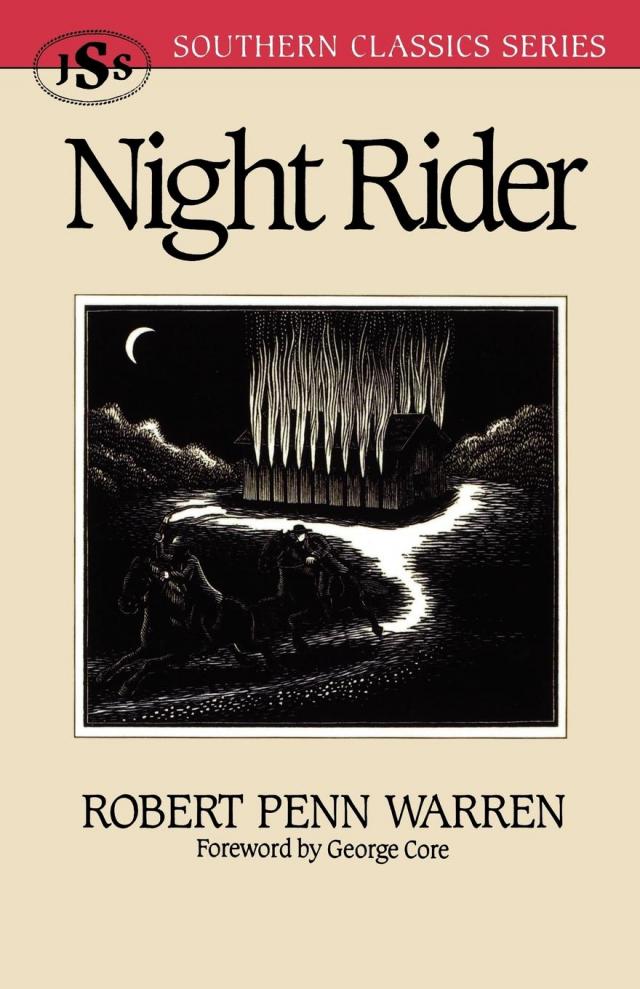


Night Rider
Southern Classics Series
M. E. Bradford, Editor
Southern Classics Series
M. E. Bradford, Series Editor
Donald Davidson
The Tennessee, Volume I
Donald Davidson
The Tennessee, Volume II
Caroline Gordon
Green Centuries
Caroline Gordon
None Shall Look Back
Caroline Gordon
Penhally
Augustus Baldwin Longstreet
Georgia Scenes
Andrew Nelson Lytle
Bedford Forrest and His Critter Company
Andrew Nelson Lytle
A Wake for the Living
Thomas Nelson Page
In Ole Virginia
William Pratt, Editor
The Fugitive Poets
Elizabeth Madox Roberts
The Great Meadow
Allen Tate
Stonewall Jackson
Robert Penn Warren
Night Rider
Owen Wister
Lady Baltimore
Stark Young
So Red the Rose
Night Rider
ROBERT PENN WARREN
with a foreword by George Core
Copyright © 1939 by Robert Penn Warren
Copyright © renewed 1966 by Robert Penn Warren
Foreword to this edition © copyright 1992
by J. S. Sanders & Company
Published by arrangement with the William Morris Agency
on behalf of the Estate of Robert Penn Warren
All rights reserved. No part of this publication may be reproduced or transmitted in any form or by any means, electronic or mechanical, including photocopy, recording, or any information storage and retrieval system now known or to be invented, without permission in writing from the publisher, except written for inclusion in a magazine, newspaper, or broadcast.
Library of Congress Catalog Card Number:
92-082382
ISBN: 1-879941-14-7
Published in the United States by
J. S. Sanders & Company
P.O. Box 50331
Nashville, Tennessee 37205
Distributed to the trade by
National Book Network
4720-A Boston Way
Lanham, Maryland 20706
1992 printing
Manufactured in the United States of America
TO
DOMENICO BRESCIA
AND
DANIEL JUSTIN DONAHOE
IN GRATITUDE
Although this book was suggested by certain events which took place in Kentucky in the early years of this century, it is not, in any strict sense, a historical novel. And more particularly, the characters in this book are not to be identified with any actual persons, living or dead, who participated in those events.
Foreword
What good fiction gives us, Robert Penn Warren observes, is “a powerful image of human nature trying to fulfill itself.” He continues: “Neither the economic man nor the political man is the complete man: other concerns may still be important enough to engage the attention of a writer—such concerns as love, death, courage, the point of honor, and the moral scruple. A man has to live with other men in terms not only of economic and political arrangements; and he has to live with himself, he has to define himself.” Although Warren is responding to Hemingway and his fiction in this passage, what he says applies equally well to much of his own fiction, including his brilliant first novel, Night Rider (1939).
Percy Munn, the protagonist of the novel, tries to define himself in economic—and, more especially, political—terms; but he is far more engaged by the roil and ruck of human possibility that Warren limns—“love, death, courage, the point of honor, and the moral scruple”—than he is by mere economic considerations or even by political necessity. Of course no one can compartmentalize every urge and pressure, every idea and attitude and emotion, in his or her life; and any person, real or fictive, will be subjected to the pressure of events beyond his or her control and understanding. Mr. Munn finds himself buffeted by events throughout the action.
The opening sequence of the novel dramatizes the blind force of circumstance in a simple yet beautifully dramatic way as Munn, standing in a train pulling into Bardsville, Kentucky, finds himself caught in the press of moving bodies as the train brakes—feeling “the grinding, heavy momentum.” “The gathering force which surged up the long aisle behind him like a wave took him and plunged him hard against the back of the next man.” Munn has been unable to brace himself properly against that powerful blind force. Mr. Munn never finds his moral bearings and, unable to brace himself, continues to be buffeted by human circumstance. In that image, caught in the action of the packed lurching train, Warren dramatizes a principal theme in Night Rider: “Mr. Munn again resented that pressure that was human because it was made by human beings, but was inhuman, too, because you could not isolate and blame any one of those human beings who made it.”
One of the ironies of Munn’s situation is that he is not only an attorney but a leader in the movement in which he finds himself enlisted; yet, despite his profession and his position of authority, he is unable to follow a course consistently moral and right. There are many instances of this failing, but the most obvious involves his defense of Bunk Trevelyan, who has been charged for murder. Munn, in defending Trevelyan against what he thinks are groundless charges, subverts the judicial process and causes an innocent man to be hanged. Later he realizes Trevelyan is more nearly a fascist than a representative example of the common man, and Munn recognizes that, despite his good motives, he has acted wrongly. Trevelyan, he perceives, is in some respect the dark side of himself, his brutal alter ego. And in the same manner Mr. Munn reacts strongly against Senator Tolliver because he fears that the opportunistic Tolliver’s weakness, his tendency to make accommodations and his inability to remain true to a cause, will infect and undermine Munn himself. On the other hand Munn betrays Mr. Christian, and he in turn is betrayed by Professor Ball. Only Captain Todd remains true to himself and his principles as the Association of Growers of Dark Fired Tobacco reels out of control, moving from a democratic to a revolutionary organization, and finally standing for much the same values as those its makers originally bridled against when they organized themselves to fight the vast power of the tobacco companies that colluded against the growers by holding down the wholesale price of dark tobacco. After the growers march on Bardsville and fire the warehouses there, this world goes mad, with the night riders attacking not only the public enemies of the Association but their own private enemies. One is reminded of the Reconstruction South and of contemporary Ireland, but the larger significance of the novel suggests the beginnings of the Third Reich and the Soviet Union as democratic ideals are set aside for totalitarian ends.
Such were the discontinuities and disruptions occurring in western Kentucky during the tobacco wars that raged when Robert Penn Warren (1905–1989) was a little boy. Warren gives us not only the men and the motives that drive them but presents the whole flavor of this world—its sights and sounds and smells, its texture and tonality. Percy Munn, who comes from farming people, is himself a farmer as well as a lawyer; and he constantly measures the weather of his days despite his knowing that weather has nothing to do with his real expectations. But it is his exact sense of the natural world that enables us to savor the life of the small town and the spacious outlying country punctuated by plantations and small farms, country joined by the railroad and traversed by horse or train.
As Percy Munn retreats farther and farther from the community and becomes more isolated and alienated from the human communion, he loses the ability to love anyone, even himself. First his love for his wife, May, withers; and then his affection for Lucille Christian dies as well. In this process his commitments become more abstract and less human, real, and binding; and finally his only friend is Willie Proudfit, who gives him refuge after he falsely is suspected of murdering a witness—another of the novel’s many biting ironies.
Munn stands at the head of a long line of Warren’s idealistic protagonists who are undone by their idealism. Their very efforts to achieve their ideals, often by immoral or even illegal means, undermines their goals, shakes their senses of identity and their values, and forces them deeper and deeper into the maelstrom of the self. Willie Stark, the leading figure in All the King’s Men, is but the most obvious instance. By the end of Night Rider Percy Munn has lost everything, but he is still “poised on the brink of revelation,” as he has been throughout the course of the unfolding action.
Although Night Rider is Warren’s first published novel, it was the third that he wrote; and it came out of a considerable period of gestation. His first published work of fiction, a long story entitled “Prime Leaf” (1931), concerns many of the same issues and involves the same setting and situation, an instance of what Abraham Cowley called “troublous times,” “the best times to write of but the worst to write in.” Warren quotes Cowley and then explains: “A period of cultural and moral shock, short of the final cataclysm, does breed art. . . . When the pieties are shaken, you are forced to reexamine the whole basis of life. A new present has to be brought in line with the past, and the other way around.” Such is the situation explored in Night Rider, and Warren suggests that the reason this particular story picked on him is that writing about it enabled him to find its essential significance, the meaning that had eluded him wh en he heard it growing up in Guthrie, Kentucky, and then when he first wrote about it in “Prime Leaf.”
This story and its ramifications embodies Warren’s essential fictive action and plot. The idealistic hero, searching for his place in the world, is misled by his motives and caught in the coils of his idealism. And, in searching for the meaning of self and trying to achieve selfhood in the uncertain world of action and liability, a world fraught by change, he is undone. Hence his effort often takes on a tragic dimension or cast, as Robert B. Heilman and other critics have argued. We are reminded of Aristotle’s definition of tragic action in his Poetics: the story of “an intermediate personage, a man not preeminently virtuous and just, whose misfortune, however, is brought upon him not by vice and depravity but by some error of judgement” (Butcher translation). Munn, who is such an “intermediate personage,” makes a series of such mistakes in judgment, as do many of his associates, with the result that the Association finally becomes a revolutionary and totalitarian organization.
In contemplating the brilliance of The Tempest, Mark Van Doren observes that the play is like an electric field in that it lights up if you touch it at any point. This splendid metaphor applies to any enduring work of literature in that there can never be any final reading or any critical orthodoxy about it (I deliberately echo Brooks and Warren on the critical response)—and that there will always be more than one way of interpreting such a work, whether it be fiction or poetry or drama or still another literary mode. You can read Night Rider not only as a tragedy of defeated expectations but as an allegory (with Munn as Everyman), as a mystery (with the subplot involving Bunk Trevelyan signifying the novel’s larger action), as a novel embodying archetypal American experience (in which case the Willie Proudfit story is essential), and as a naturalistic novel (with Munn caught in the vise of circumstance and event beyond his control to alter or affect). You can also view it, as is the case with any novel by Warren, as a fiction partaking of both the romance and realism that run through the classic American novel in the ways long ago described and defined by Richard Chase and Daniel Hoffman.
My own view is that the novel’s weaknesses derive from its being, on occasion, too allegorical on the one hand or too naturalistic on the other. The only other defect of real magnitude that I find in it is that the author rushes the action toward the end, forcing the conclusion. The novel might have been stronger were Percy Munn to confront Senator Tolliver in the same way that he does and then to flee toward the West. But this is a small point, perhaps even a quibble.
In any event, regardless of how one views the action of this superb novel, he should see it as one of the best first novels written over the history of American fiction from Nathaniel Hawthorne to the present time. There are few first novels that are better—perhaps only Sister Carrie and The Sun Also Rises. Hawthorne did not do so well in his first novel, nor did Herman Melville, Henry James, and a great number of other important American writers. And Night Rider is by any reasonable measure a powerful work of fiction for which no apology need be made. It is obvious that Warren, in writing Night Rider in his early thirties, did not think of himself as a young writer whose miscues and mistakes “ought to be forgiven.” He knew even then what he would say twenty years later at Vanderbilt University about the young writer: “Nothing will be forgiven. It will stink just as much if you did it as if Hemingway did it.” And so he played for keeps, and playing at those high stakes, with everything to win or lose, he wrote what Andrew Lytle has said is his best novel—his most finished and fulfilled.
Night Rider’s power and urgency and subtlety continue to move us and to appeal to new generations of readers. It is a novel that bears rereading and that repays our closest scrutiny. To expect more of any literary work would be preposterous.
Sewanee, Tennessee
GEORGE CORE
Night Rider
Chapter one
WHEN the train slowed at the first jarring application of the brakes, the crowd packed in the aisle of the coach swayed crushingly forward, with the grinding, heavy momentum of the start of a landslip. Percy Munn, feeling the first pressure as the man behind him lurched into contact, arched his back and tried to brace himself to receive the full impact which, instinctively, he knew would come. But he was not braced right. The gathering force which surged up the long aisle behind him like a wave took him and plunged him hard against the back of the next man. He felt his face ground against that shoulder, and caught the sour smell of sweat and the smell of the lye soap in which the blue shirt had been washed. He discovered that he had stepped on the man’s foot. Then Mr. Munn righted himself.
The man, when he half-turned his head and showed his long, red, bony face, looked even taller than before.
‘Excuse me for stepping on your foot that way,’ Mr. Munn said.
‘Hit ain’t yore fault none,’ the man answered. He paused ruminatively, and then: ‘That feller, he ain’t fitten to run no train.’
Mr. Munn shook his head.
‘Naw,’ the man repeated, ‘he ain’t fitten.’
We ought to be getting in, Mr. Munn thought; but the crowd was too close-packed for him to lean over and look out the windows. The train, however, was slowing a little. He could see the people in the seats with their heads now craned out the windows and could hear their shouts and exclamations. Their excitement communicated itself to the whole mass so that men pressed to bend and look out, demanding to know if they were getting in and what was out there and could you see the crowd. Over the sound of the wheels on the rails and the noises of the people, Mr. Munn heard some man, far back toward the other end of the coach, shouting, ‘We gonna do it! We gonna do it!’ Over and over again, like a chant.
Then the brakes jammed on hard again, and as he again braced himself to receive the impact, Mr. Munn felt a momentary irritation and disgust with that dead, hot weight of flesh which would plunge against him and press him, with the shouting and talking, with the smell of sweat and whisky, and with the heat of the day and of the crowded bodies. A crowd, he thought, and no better than any other crowd. I ought to be out home, regretting that he had come.
The tall man in front again turned his head, saying, as though in sadness, ‘He went and done hit agin.’
‘Yes, he did,’ Mr. Munn replied.
‘He oughtn’t to do hit,’ the man was saying. ‘That-air jousten and jolten lak that don’t do folks’s innards no good.’
‘No,’ Mr. Munn said.
‘I said that feller wasn’t fitten to run no train,’ the man asserted, ‘and he ain’t fitten.’
‘No,’ Mr. Munn said.
The train had stopped.
The pressure behind now was not the dead weight of bodies flung forward by the abrupt slowing of the train, but a pressure generated by the wills of all those people behind him, people who wanted to move down the aisle and get off the train and get into the streets of Bardsville, where more people, only God knew how many, would be today. And as the movement of the crowd pushed him toward the door, Mr. Munn again resented that pressure that was human because it was made by human beings, but was inhuman, too, because you could not isolate and blame any one of those human beings who made it. Anyway, he was glad May hadn’t come into all this, and fleetingly thought of her as he had seen her last that morning, in a white dress, standing on the porch, at the other end of the row of sugar trees, and waving to him as he got into the buggy that was to take him down to the crossing where he could flag the local.
The crowd pushed him through the door. He was aware, as the glare of the morning sun struck his eyes, half-blinding him after the dim interior of the coach, of the solid mass of faces that filled the little platform of the station and the space of the street beyond. The tall man ahead of him half-turned on the steps of the coach, saying, ‘Gre’t God!’ loudly and solemnly, ‘I never, I never in all my days seen so many people.’ Mr. Munn thought that he, too, had never seen so many people, never before, and as he looked out over the faces — so many of them, it seemed, upturned toward him, as though in greeting or expectation — he felt a sudden surge of excitement, almost of exaltation. ‘Great God!’ he said, echoing the tall man; but the tall man had stepped down.