

Easy to be a god, p.18
Easy to Be a God, page 18
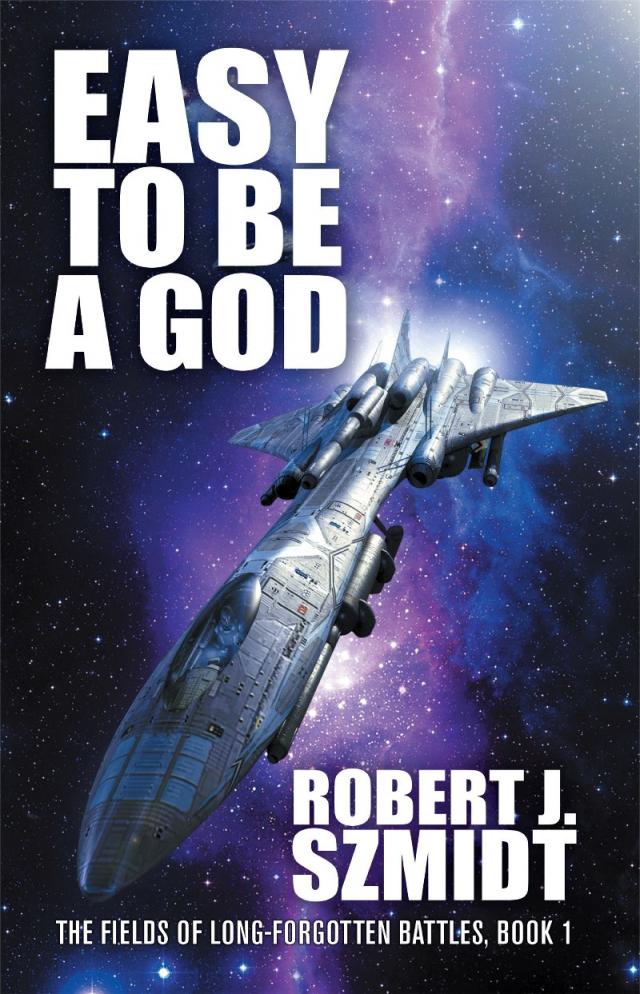


On the plain, far from the edge of the foothills, gathered all the clans of the north. Facing each other were a hundred thousand Warriors of the Bone and the Gurdian army, three times more numerous and considerably better equipped. The enemy was rested, knew the area perfectly well, and wasn’t going to delay the battle.
In spite of this, the sithu was sure of victory—firearms more than compensated for any weakness. Unfortunately, he forgot one thing: the fast marching pace prevented the purging of the occupied territories. It was his worst mistake. Just before the decisive battle, the scattered clans following the armored troops hit from behind and attacked the Gurdian army, which was preparing for a fight. Suhurs wreaked havoc in the support area. Taih’law fell in the first moments of the attack. With him died the majority of Gurds that stayed in the headquarter tents. As luck would have it, the Warriors of the Bone struck when the sithu called a council in order to discuss the battle plan with the troop commanders. Not a single senior officer survived the slaughter. Soon a horde of battle-hardened natives fell upon the tired, confused, and lacking orders Gurdian soldiers. The largest massacre in Beta’s history had begun.
Having no chance to escape, Gurds decided to resist till the last drop of blue blood. They died en masse, but also took whole clans down with them. When the smaller sun disappeared behind the mountain peaks, the grassy plains were covered with a blue-brown sea of gore. Only a few hundred invaders managed to flee, taking advantage of the confusion. Less than six thousand Suhurs returned to the hills after dark. They won, but it was a Pyrrhic victory, which they learned during the subsequent clashes of the suns, when the successor of Taih’law, Sithu Her’hot, brought another, although much less numerous army.
The survivors told the commander about the tactics adopted by Suhurs. It was clear that the decimated clans were not a threat anymore. The new sithu realized almost immediately that he had a big chance of ending this war and defeating the enemy once and for all. As to the training of a new army, he suggested not doing it, because it would take a few or even a dozen floodings, and instead he advised the Supreme Council to concentrate in the north all the forces available in Suhurta, which could be achieved by reducing the number of garrisons in other parts of the continent (at that time the natives’ attacks were rare, especially in the central plateaus and the south, where finding a Warrior of the Bone would have been a miracle). The Supreme Council agreed to his proposal.
Tens of thousands of soldiers had been relocated, leaving in place only the troops from the far south, where the clans hiding in the mountains were still a little threat to smaller circles. This allowed Her’hot to purge the territory which Gurds had won in the previous campaign. A young, although ambitious and clever, sithu won the foothills much faster and easier than his superiors expected. Gurdu’dihan gained a new hero.
The penultimate act of the war between the two Beta races ended many years later, when the last clans, defending their seats in the Seven Pinnacles, were driven off. At that time, all the lands south of the mountain range had already been parceled out and settled. The Warriors of the Bone were pushed to the most inhospitable part of the continent, where they had too little space to be able to regain their former glory.
Her’hot didn’t get to put an end to the conflict. Although he didn’t lose a single battle, he was defeated by the climate and diseases. The time spent in the high mountains, camping in dank caves, all this took a toll on his delicate health. The sithu expired with dignity, transported by aircraft to the capital, where—till the very end—he enjoyed reverence and respect worthy of the greatest hero.
A few floodings later, Sithu Taba’ruk, the new Gurdian commander in Suhurta, marched onto the last highland, leading an army consisting of veterans only. He also deployed the scorched earth tactics, but the territory was more difficult, and the last clans put up a fierce resistance. The Warriors of the Bone finally learned to fight using ruse—which, given the centuries-old history of the conflict, wasn’t a huge achievement—and made Bluebloods pay a high price for each occupied rock or shrub.
The Supreme Council had finally come to the conclusion that further bloodshed didn’t make sense. The closer soldiers approached the northern, far reaches of the continent, the colder it got, plus the rocky terrain behind the Seven Pinnacles was infertile and, in Gurds opinion, not worth such a high price. Further action was thus abandoned when the armies of Taba’ruk reached the Valt Aram, the last major river of the continent, and stopped less than twenty thousand wheel revolutions from the rocky cliffs, where, according to some ancient maps, the mainland ended. The riverbank was fortified, the fords were deepened, the conquered lands parceled out to soldiers dismissed from service. The Warriors of the Bone had been almost wiped out. As they were no longer able to threaten the new empire, their remnants were left to fend for themselves, and cut off from the rest of the world with the border running along the bed of a wide river that started in the high mountains of the east and flowed into the sea far to the west. Despite all this, Suhurs incessantly stirred up trouble; although they only attacked the border circles, destroying crops and slaughtering the settlers and their livestock, Gurds were forced to maintain a number of garrisons in this region.
This state of affairs lasted for almost thirty floodings, but was about to change. The Supreme Council of Gurdu’dihan, wanting more than ever to get rid of all the weapons, decided that they must settle the matter once and for all.
TWENTY-THREE
THE XAN 4 SYSTEM, X-RAY SECTOR
09/06/2354
It’s about time to solve the last puzzle, thought Darski, entering the maglev car.
On the fourth morning, after passing a short theoretical knowledge test on Beta and the project, he started his first watch. The command center, for which he was heading, was located in the sector four, exactly on the opposite side of the rim. The workspace and living quarters of this giant station consisted of eight segments, each four floors high and with a length of almost a mile and a half. Every segment was divided into five smaller compartments that could be disconnected from the rest of the structure.
Sectors one, two, seven, and eight served as living quarters, in the third there was the research center (whose staff lodged in sector two). The fourth sector housed the headquarters, including the command center that was the heart of the entire station. Sector five was sealed off—the Department of Fleet Security had located there their lockups, interrogation rooms, and such other places, of which most people preferred not to know. The last—if a wheel has an end—sixth sector, housed the medical department, and the doctors lived in the sector seven. The eighth one was reserved for the military, and the first one for technical staff.
Henryan looked around the spacious car. Apart from him, in a brightly lit cylinder were doctors, engineers, scientists, and several gendarmes. Not a single familiar face, he thought. Even though he hadn’t met many people during the three days of his intensive training, he still hoped to meet the guys with whom he ate meals at the mess hall somewhere on his way.
The express train, the fastest of the three lines available on the rim, stopped at every fifth station, always in the central part of the segment, spitting and swallowing a host of people.
Darski got lucky at the second stop. In the medical sector, thoughtful Valdez entered the car. He was holding a whole bunch of readers under his arm.
“I’ll help you,” the sergeant said, moving closer to the superior.
The lieutenant looked at him absentmindedly as if he didn’t recognize the subordinate, but after a second, he blinked with a gleam of understanding in his eyes.
“Oh, it’s you, Sergeant Pry,” he said stiffly, but let Henryan take part of the documentation. “Excuse me, Sergeant, I had a rough night.”
“A party in the officers’ club?” Darski smirked.
“I wish,” Valdez replied, keeping a straight face. “Work. If I were you, I wouldn’t count on a lot of free time in the near future.”
“Are you going to go to perform your duties in such a state?”
“Of course not. I’m going to report to the old man and then go to bed.”
The maglev stopped at the additional stop in the sealed-off sector. No one disembarked, but two “esdees”—Security Department officers—got onto the train. If it hadn’t been for the huge height difference, they would have looked like twins—shaved heads, black uniforms, gray headreaders, grim faces. The lieutenant stepped back against the wall and nodded to Henryan. Apparently, it was better not to get in their way …
“Why were the other three expelled?” Darski asked in a hushed voice.
“Who do you mean?” the still distracted officer mumbled.
“Those orange ones,” clarified the sergeant. At the same time he noticed that one of the agents perked up his ear. The implants gave the bastards superhuman hearing.
“Orange?” Valdez repeated, stupefied.
It was clear he hadn’t yet recovered from a rough night.
Another additional stop, unnamed, sealed off by the force barrier. The buzzkills got off the train without speaking even once.
“Arrival, replacement,” Darski tried to put the lieutenant on the right track.
“Do you mean Seifert and his guys?”
“Yes, if it was them who were hopping in the direction of the shuttle on which I flew in,” answered Henryan.
Lately, he’d often wondered to himself what the reason for the arrest of the previous communications officer was. He hadn’t learned it in the first briefing, and the news about Aliens was so shocking that all other issues got immediately forgotten. Later, during the training course, he preferred not to ask.
“They had a whim to play God.” Valdez smiled at his thoughts. “And so they were thrown into hell.”
“Pardon?” Henryan frowned.
If he understood the lieutenant correctly, his predecessor received a one-way ticket: he was sent to the legendary secret prison from which no one had yet returned. Although this mention of God … No, it must have been just a metaphor.
“You’ll find out everything. Soon, too.” Valdez looked at him askance.
Henryan sighed. Either his new boss badly needed rest, or he didn’t know too much.
“I’m sorry, sir, but I really don’t understand any of that.”
“Trust me, Sergeant Pry, it is better for you this way. You don’t understand anything, you don’t know anything, and you are not interested in anything. You follow orders and don’t really care about the rest of it.”
“Quite a reasonable approach,” Darski admitted.
“Especially in your situation,” Valdez said. “You’re new here, you have no clue about what’s going on down there.”
“I know a little about the project. For three days, they were making me learn the flora and fauna of Beta. Not to mention the history of inkblots and savages.”
“I don’t mean Aliens, but our own,” Valdez corrected him. “While the scientists are more subordinate than robots, the gendarmes are bored and constantly come up with unfortunate ideas. Like sending a nanobot to some bard to whisper a well-known song, or teaching the inkblots how to make moonshine from local grain.”
“Good one!” Henryan laughed, but immediately went silent, having noticed a rebuking glance of his superior.
“Do you really feel like wearing an orange outfit?” Valdez asked, lowering his voice.
“No, sir.” Darski was momentarily serious.
“These are alien races, civilizations older than ours, although much more primitive. We have no right to interfere with their lives. It’s their world and their history. Do you realize how valuable the results of the observations we take down there can be?”
“I understand the importance of scientific research, but I think a life sentence for such trifles is a bit of an exaggeration.”
“If you were really thinking, Sergeant Pry, you wouldn’t have spent three years in a penal colony, or said what I just did not hear.”
“Yes, sir.”
The lieutenant looked him straight in the eyes, and then looked around warily as if to check that no one was eavesdropping. Satisfied, he leaned toward Darski.
“This is not about trifles. Extra shifts, demotion, a month’s detention … Until recently, such antics entailed standard penalty, but a few weeks ago, there was a dramatic escalation of this foolishness.” He glanced at his personal reader. They were less than three minutes away from the command center. “Dr. Fukkuya first reported the strange behavior of the savages. On more than one site, he observed that the Warriors of the Bone perform new rituals. Imagine that they ended their customary prayers with the sign of the cross, just like Christians do. This raised legitimate concerns among the scientists. We enhanced the monitoring of the whole sector and after just two days, we knew that one of the Suhurian fisters had had a vision, in which the Spirits of the Mountains—those are minor deities, a sort of the clan’s guardian angels—provided the following information: gods turned their back on Suhurs, dooming them to destruction. Of course, the tutelary entities didn’t want to accept it.”
Darski shook his head.
“That’s some kind of nonsense …”
“Not entirely,” Valdez cut in. “The monitoring tells us that the Supreme Council of Gurdu’dihan has recently approved the plans of the decisive campaign. Gurds will set out soon; the orders are traveling by sea as we speak, along with draftees for the sampo-sithu’s army. For Suhurs, this means an imminent extermination, which we will watch passively in line with our orders.”
“So Seifert’s at fault for sending them a warning?”
“The mere warning wouldn’t be a problem, especially since we are looking at the last moments of this race. You see—there’s no way we could have long-term effects of these antics.” Lieutenant Valdez lowered his voice even more. “Two weeks ago, at about fourteen hundred hours orbital station time, the satellites received a signal from the planet’s surface. Someone used a plasma weapon on the northern continent. Can you imagine? Can you imagine the chaos which erupted here when it turned out that the savages got Earthian weapons in their sticky paws? The old man lost it. This mission has the highest priority. The scientific department of the Federation’s government invests a staggering sum in it.”
Valdez nodded at the wall of the car, but he probably meant the whole station.
“Whenever a report on the smallest incident reaches the Central Systems, we have at least three admirals on our back, and the scientists don’t idle: when they see an unauthorized interference with the natives, they immediately put it on paper, so to speak. This is not a game, Sergeant Pry. We have to be invisible and inaudible. We observe and research. We never interfere. Come hell or high water. And this—” For a moment, he was lost for words. “This was a terrible villainy. One such shot could change the history of Beta.”
“I think you’re exaggerating, Lieutenant. How could one … ?”
“Very easily.” Valdez looked up at the puzzled subordinate. “The inkblots are launching the last crusade. It will be led by Sampo-sithu Takeli’toko, their spiritual and military leader. Imagine what would happen if just before the battle, or in its course, his tent and all the surroundings suddenly evaporated in the heat of a big explosion, just as it’s been foretold? Yes, foretold. This is another trick of our pranksters. Gurds are a more advanced civilization, they’ve recently entered an industrialization phase, but for many thousands of years—which, incidentally, really puzzles me—they haven’t developed any religious beliefs.
“And now, thanks to some moron, they would receive quite tangible proof of the existence of a supreme being. A supreme being which sides with the savages, their longtime enemies. It would change the course of history of not one, but two civilizations!” he hissed in a stage whisper.
“The chosen people …”
“There you go. After all, you get a thing or two.”
“But—”
They reached their destination. The doors slid open noiselessly, letting them out into a wide cylindrical corridor. At its end one could see three open armored bulkheads and as many entrances guarded by the shimmering force barriers. The command center lay beyond.
“But me no buts,” Valdez said after they’d disembarked. “Fortunately, the savages couldn’t keep their hands off the weapon and used it prematurely, even though Seifert repeatedly warned them not to do that. Thanks to their insubordination, we were able to trace the contraband weapon. The Cerberus Orbital Defense System removed the threat immediately. A few seconds after the shot, both the phaser and the shooter were vaporized, and we started looking for the clone-of-a-bitch who’d made this mess. And so we tracked down the bastard, although it wasn’t easy, because he had been stealing weapons from our armory for a long time, albeit in pieces. Then, following the clue, we found the one who’d delivered the phaser down, and in the end we got the coordinator of all these actions. It’s him that you have replaced, Sergeant Pry. You must wonder sometimes why someone gave you a chance, even though they shouldn’t have?”
Henryan nodded, curious about the answer.
“The old man needed for this position someone he could completely and utterly rely on. Someone who can’t be bought the way Seifert was. You, Pry, won’t give him any trouble. You’ve already learned the hard way what the punishment for insubordination is. You’d better not forget that you’re out on parole.”
“I will not forget, sir,” Darski assured him sincerely when they’d passed the checkpoint. “I don’t understand, however, what the problem is. After all, you’ve busted the guilty parties and destroyed the contraband weapon.”
“The old man will explain everything to you.” Valdez nodded at the circular dais of the command station, then patted the documents he carried. “It looks like the Seifert’s case was the proverbial tip of the iceberg.”






