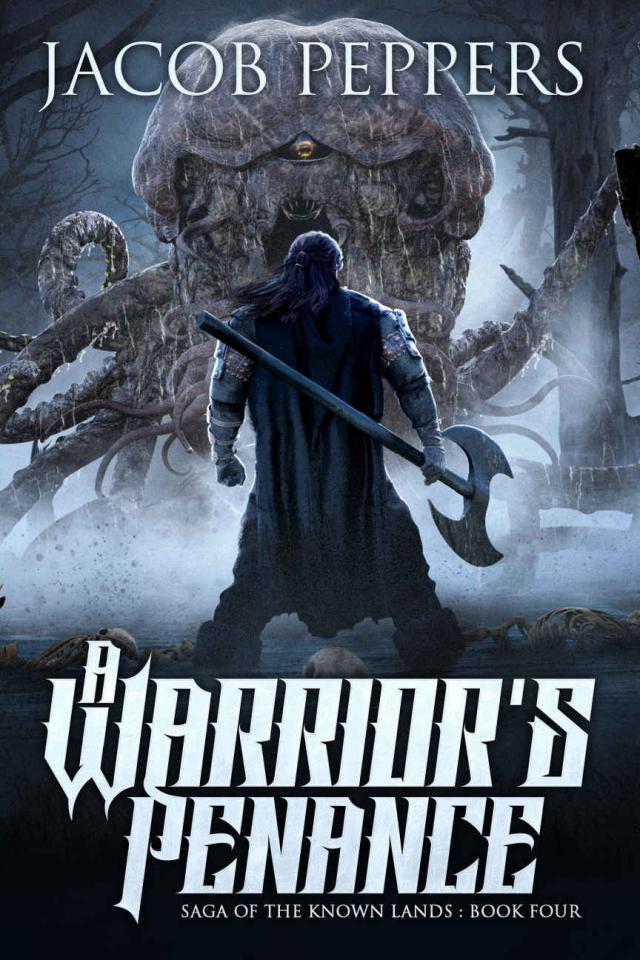
A warriors penance, p.1
A Warrior's Penance, page 1
part #4 of Saga of the Known Lands Series


Contents
Copyright
Dedication
Newsletter Signup
CHAPTER ONE
CHAPTER TWO
CHAPTER THREE
CHAPTER FOUR
CHAPTER FIVE
CHAPTER SIX
CHAPTER SEVEN
CHAPTER EIGHT
CHAPTER NINE
CHAPTER TEN
CHAPTER ELEVEN
CHAPTER TWELVE
CHAPTER THIRTEEN
CHAPTER FOURTEEN
CHAPTER FIFTEEN
CHAPTER SIXTEEN
CHAPTER SEVENTEEN
CHAPTER EIGHTEEN
CHAPTER NINETEEN
CHAPTER TWENTY
CHAPTER TWENTY-ONE
Stop by and say hello!
Newsletter Signup
About the Author
Note from the Author
This book is a work of fiction. Names, characters, places and incidents are either the product of the author’s imagination or are used fictitiously. Any resemblance to actual persons, living or dead, or to actual events or locales is entirely coincidental.
A Warrior’s Penance: Saga of the Known Lands Book 4
This ebook is licensed for your personal enjoyment only. This ebook may not be re-sold or given away to other people. If you would like to share this book with another person, please purchase an additional copy for each person you share it with. If you’re reading this book and did not purchase it, or it was not purchased for your use only, then you should return to the retailer and purchase your own copy. Thank you for respecting the hard work of the author.
Copyright © 2022 Jacob Nathaniel Peppers. All rights reserved, including the right to reproduce this book, or portions thereof, in any form. No part of this text may be reproduced, transmitted, downloaded, decompiled, reverse engineered, or stored in or introduced into any information storage and retrieval system, in any form or by any means, whether electronic or mechanical without the express written permission of the author. The scanning, uploading, and distribution of this book via the Internet or via any other means without the permission of the publisher is illegal and punishable by law. Please purchase only authorized electronic editions, and do not participate in or encourage electronic piracy of copyrighted materials.
The publisher does not have any control over and does not assume any responsibility for author or third-party websites or their content.
Visit the author website: http://www.jacobpeppersauthor.com
To mom
There’s no way to thank you for all that you’ve done for me,
Not without making this dedication a second book
Still, let this stand as yet another poor attempt.
Thank you. For everything.
I could not ask for a better mom, nor my children a better mema.
Sign up for the author’s mailing list and for a limited time receive a FREE copy of The Silent Blade, prequel to the bestselling fantasy series The Seven Virtues.
Click here to get your free book now!
CHAPTER ONE
He knelt on the hard packed earth of the training circle, panting for breath. His fingers clawed into the dirt, and there was a dull but painful throb in his back where the practice sword had struck him. The ground was blurry beneath him from the tears gathering in his eyes, tears not of sadness or pain but of rage, a rage that seemed, at any minute, that it might sweep over him like some great tide, carrying him where it would.
“Get up, boy,” a voice said.
But he could not be back here, for he knew this place, just as he knew that it did not exist any longer. It was from a time before the Skaalden came, before the world had gone dark. I’m not a boy, Cutter thought. I’m a man grown. I have been for a long time—too long, I think. He knew this, yet he knew too, that he was a boy, and that boy knew little else at that moment but his anger. Anger which made him snatch up his own practice sword from where he’d dropped it when struck.
He rose to his feet, his chest rasping with breath and turned to regard Darius, his father’s master-at-arms.
But that can’t be, he thought, you’re dead. You died to the Skaalden. And yet, despite this, the man stood before him, his arms crossed, the look on his face the one that he often got when Cutter—when Bernard—disappointed him. “It isn’t fair,” Cutter said, waving at his opponent only to see that it was not, as he’d expected, one of the children he’d so often trained with. Instead, it was only a shadow. It could have been anyone or no one.
“It isn’t fair,” he said again. “It’s too much. They…they’re too strong.”
The next he knew, Darius was no longer standing but kneeling in front of him without having moved. “Look at me, boy. Look at me.”
Left with no choice, Cutter did.
“Do not tell me that it is too hard, that they are too strong,” the master-at-arms said. “Life is hard, boy, and any man who wants to live it had better learn to be hard too, do you understand?”
“I…I…”
The world blurred then, shifted, and when it resolved he was no longer standing in the circle of the training ground but instead inside in the audience room of his father’s castle. People were everywhere, milling around, clearly terrified. Cutter stood at a strategy table with his father and the king’s closest advisors. “You are strong, Bernard,” a voice said, and he looked to see that it was Darius again, standing next to him, “even you do not fully understand that strength, but you will in time. Use it—protect them.”
He opened his mouth to answer but then the audience room, too, was gone, vanishing as if it had never been. In another moment he stood in his old room in his father’s castle. His father stood at the window, gazing out, his hands clasped behind his back. “Do you know what the greatest challenge is for a king, Bernard?”
“I…I don’t…”
“It is not dealing with the merchants—though they present their own…unique challenges. Nor is it dealing with rebellions or bandits or taxation or any of the other issues my advisors so love to discuss. Instead, a king’s greatest challenge is the same as that of any man or woman on the face of the world.” He turned then, regarding Cutter with that questing expression he often had when he was trying to teach him something. “Do you know of what I speak?”
Father, he thought. Oh, fire and salt, how I have missed you. Please, help me. Tell me what to do. But he was not in control here, not any more than he had been in control at the training grounds with Darius, so instead he said, “No, and I don’t care. I am sick of your lessons, Father, sick of always being told I’m not good enough.”
“No one is good enough, Bernard,” his father said softly. “You should never be satisfied—for a contented man does not grow, he only lingers. Now, answer my question, and I will leave you in peace. What is a king’s greatest challenge?”
The young Cutter snorted. “Getting his sons to listen to him, I imagine.”
His father smiled sadly at that, and Cutter felt his heart reach out to him, wishing he could take back the words. But the past lay in the past, beyond his reach, and he could not change it no matter how much he might wish to. “Son,” his father said softly. “A king’s greatest challenge, the greatest challenge of all men, is to get back up. The world will knock you down, Bernard, and the higher a man rises the greater that fall may become. It will knock you down, and the greatest challenge you will face, when it does, is getting back up again. Do you understand?”
“I guess.”
“Listen to me, Bernard,” his father said, meeting his eyes. “You must always get up. No matter what happens, no matter what difficulty you face, you must always keep going. Do you understand? Keep going.”
“Alright,” he said, “alright. I will.”
“Bernard? Bernard? Bernard!?”
He roused as if from a dream, giving his head a shake, and saw that he no longer stood in his old quarters in his father’s castle. Instead, Cutter now stood in the Black Wood, the home of the Fey and seat of their power. Feledias stood several feet ahead of him, frowning, a worried expression on his face.
“What?” Cutter croaked. “What, is it, Fel?”
“You seemed…I don’t know, out of it.”
“I’m fine,” Cutter said, giving his head a shake to rid it of the vestiges of the daydream. He immediately regretted it as a wave of dizziness swept over him. He stumbled and would have fallen had Feledias not reached out and caught him.
“Fire and salt, Bernard, you’re far from fine,” Feledias hissed. “And no wonder. Why you’ve got so many wounds it looks like someone took it in mind to butcher you for meat.”
Cutter winced. “Okay, then I’ll be fine,” he said. “I just need a little rest, that’s all.”
Feledias snorted. “What you need, brother, is a good healer—maybe a team of them—and a month to recuperate.”
Cutter sighed. “Your company, Fel, is all the remedy I need.”
His brother rolled his eyes. “Make jokes if you want, but I’ll be more than a little pissed off if you die before the Fey get to kill you. I wouldn’t care to be the sole target of their attentions.”
“No doubt my corpse would be very concerned about your anger,” Cutter said. “Now, if you’re done, how about we look for a place to camp for the night?”
“Fine,” his brother said, “but as soon as we stop, I’m going to take a look at your wounds.”
“You know something of healing?”
“Some,” his brother said defensivel
“Why don’t you choose?” Cutter said.
“Joy,” Feledias muttered dryly. “Well, come on. I suppose when a man is searching for his own gravesite, one spot is really as good as another.” He led them to a small, secluded patch of ground in between several giant trees. Normally, such a place would have given Cutter some comfort, for the massive trunks of the trees, wider than he was at the shoulders, would serve well to hide them from any peering eyes. The problem, of course, was that, in the Black Wood, a man could not shake the feeling that the trees themselves were watching them.
Despite the assurances he’d given his brother that he was fine, it was a trial to walk the short distance, his feet shuffling through the newly fallen snow. Finally, though, they reached it, and Cutter started to remove his pack from where it was slung over his back only to wince as the movement caused a spasm of pain in several of his wounds.
Feledias glanced at him, raising an eyebrow. “I swear, nothing has changed since we were kids. Why, you’ll even go so far as to nearly get yourself killed if it means avoiding work. Just…just stand there, if you can. I’ll set up camp. When I’m done, maybe you can find another task you’d like me to do, you know, considering that by all appearances I might well be your servant.”
“Well,” Cutter said, doing his best to turn his grimace of pain into a frown, “my boots are looking a bit scuffed up. Might be they could do with a little polishing.”
Feledias snorted. “Jokes again. Careful, brother. Just because I’ve decided to hold off on killing you doesn’t mean I can’t change my mind. They don’t call me Feledias the Mercurial for nothing.”
Cutter frowned. “No one calls you that.”
“Give it time,” his brother said, walking to Cutter and removing his pack before setting it and his own down on the snow. He began to take out their meager possessions; it did not take long. Two bedrolls, some flint and tinder, and some wrapped dried meat they had purchased from a small village on their way here. Not much, but Cutter told himself that a man didn’t need much to die.
Feledias was done in a few moments, then he was turning back to Cutter. “Well? Go on and sit down, prop against that tree there. We’ll see what can be done.”
Too tired to argue, Cutter did as he was asked, stumbling to the tree and half-sitting, half-collapsing into the snow.
Feledias crouched down beside him. “This would be a whole lot easier if my fingers didn’t feel frozen stiff,” he complained. “Of course, it’d be even easier if someone didn’t take it in mind to serve as target practice for seemingly any person who owns a knife or sword in the whole damned kingdom.”
“You have my sympathy,” Cutter said dryly.
“I choose to ignore the sarcasm in that,” his brother said, raising an eyebrow, “considering the fact that I am about to try to help heal the man I spent the better part of the last fifteen years trying to kill.”
“Life’s funny like that.”
“Yeah, and it can be short too—now shut up and let me work.”
Exhausted as he was, Cutter was pleased to comply. He shut up as requested, leaning his head back against the tree and closing his eyes. Unwise, maybe, to allow himself to be so vulnerable in the Black Wood, but then they had left wisdom far behind them when they had come to this place. So he sat while his brother unwrapped the bandages covering his wounds and peered at the flesh underneath.
“Damn,” Feledias cursed after examining one such wound on his arm, and Cutter groggily raised his head. “What?”
His brother sat back, rubbing at his nose. “Damn thing stinks. That, of course, would mean infection.”
Cutter winced. That wasn’t great. He’d been in battle plenty of times, and he had seen soldiers suffer often minor wounds, celebrating their luck only to succumb to infection a few days later when the rot somehow got into the wound. He didn’t suppose there was any good way to die, but from what he’d seen that was likely one of the worst.
“How bad?”
“Well, it isn’t great, brother mine,” Feledias said. He rubbed his hands on his trousers, then cupped them to his mouth, blowing on them in an effort to work some warmth back into them. “Damn,” he said again. “I’ve got to get some herbs.” He rose from his crouch, glancing around. “I’ll be right back.”
His brother started away, pausing when Cutter spoke. “Fel?”
“Yes?”
Cutter met his eyes. “Don’t go too far.”
His brother grunted, glancing around at the giant trees, their branches seeming to reach out, eager to cover the whole world. “Wouldn’t dream of it.”
While his brother was gone, Cutter busied himself with removing his axe from the sheath at his back. It was a task that normally would have only taken a moment, but his weakness coupled with the pain of his wounds made the weapon seem heavier than it had ever been. By the time he was done, his face was covered in a cold sweat, and his skin felt flushed with heat.
He lay the axe down beside him in the snow, making sure that the handle was within easy reach. Likely it wouldn’t matter, as given his current state, he probably wouldn’t be able to defend himself against a child throwing rocks, let alone a Feyling, but then a man shouldn’t let a little thing like nearly being dead make him sloppy.
Besides which, despite his efforts to clear it from his mind, the memory he’d had in his delirium while they walked still remained, so vividly that he could almost see his father’s face before him.
“I’m sorry,” he told that specter of the past. “For everything.”
The specter, unsurprisingly, did not answer. With a sigh, Cutter leaned his head back against the tree. He was tired. His wounds, the exertion of the last few days, that was part of it but not all—not even most, in truth. He was tired in body, yes, but more than that, he was tired in his soul. Weary beyond belief. He wondered, as he sat there, if it would really be so bad, being dead. The dead, after all, had nothing to worry about, for the worst had already happened.
He remembered once, long ago, Maeve saying that it wasn’t his strength that made him so dangerous, but his will. Cutter had been drunk at the time—he had often been drunk in those days—and had laughed it off. But in the days since, he had thought about that often. A creature of will. He had played at the idea, worried at it like a dog with a bone, over and over again, turning it this way and that, examining it, trying to understand it.
Perhaps she was right, but then, if that were so, what happened to a creature of will when that will began to fade? Did the man fade along with it? Cutter thought that maybe he would, that maybe he was fading, had been fading for a long time now. Soon, perhaps he would fade out completely, and he thought maybe that would not be such a bad thing. Not for him and certainly not for the world he’d leave behind.
A life spent at war, at bloodshed, and what good had come of it? A kingdom that was broken—or nearly so—a brother betrayed, and a son who had seen the entire life he had known set ablaze. Cutter knew that Maeve, Chall, Priest, and perhaps even Matt would grieve his death, but they would get over it, in time. Priest would have his faith, Matt his kingdom, and as for Maeve and Chall, they would, if they could only stop being so stubborn, have each other. The thought entered his mind that his death might even be the thing that finally brought them together.
He liked the idea of that. Liked to think that if he could do no good in his life then at least, perhaps, he could in death.
Keep going.
He frowned, giving his head a shake. The memory was close, it was true, so close that he could almost see his father’s face, could almost hear his voice. But as close as that memory was, as close as that voice was, the darkness was closer. Darkness that was complete and unbroken, darkness that promised, if not peace, then oblivion, and he thought that in the end he could be satisfied with that. After all, it would be closer to peace than he had ever gotten anyway.