

Sentinel of earth a scie.., p.1
Sentinel of Earth: A Science Fiction LitRPG, page 1
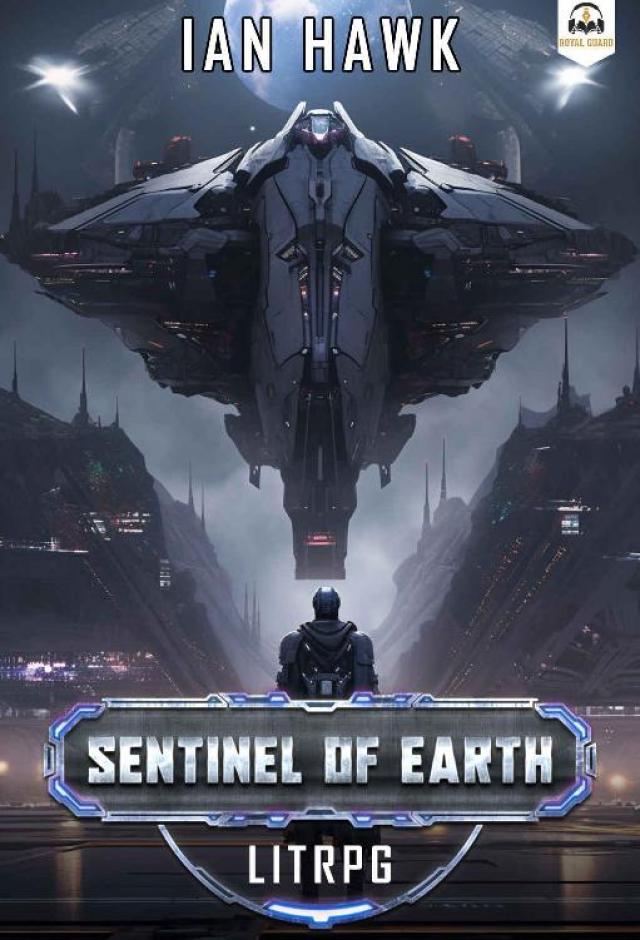


Sentinel of Earth
A SCIENCE FICTION LITRPG
IAN HAWK
Copyright © 2023 by Ian Hawk
All rights reserved.
No part of this book may be reproduced in any form or by any electronic or mechanical means, including information storage and retrieval systems, without written permission from the author, except for the use of brief quotations in a book review.
Contents
Chapter 1
Chapter 2
Chapter 3
Chapter 4
Chapter 5
Chapter 6
Chapter 7
Chapter 8
Chapter 9
Chapter 10
Chapter 11
Chapter 12
Chapter 13
Chapter 14
Chapter 15
Chapter 16
Chapter 17
Chapter 18
Chapter 19
Chapter 20
Chapter 21
Chapter 22
Chapter 23
Chapter 24
Chapter 25
Chapter 26
Chapter 27
Chapter 28
Chapter 29
Chapter 30
Chapter 31
Chapter 32
Chapter 33
Afterword
More From Royal Guard Publishing
Check this out!
Chapter
One
I’m often asked about the moment it all began, and the answer is simple: it is when everything else ended.
AD and BC became irrelevant as measures of years passed. Years became nonsense, as that length of time only applied to Earth.
It was the moment that the crew of the USM Arrowheart finally passed through the heliopause—the violent frontier where two great cosmic forces clash, the intangible membrane that separates our solar system from everything else. It was the moment humanity left the safety of its sun’s bubble.
Silence reigned as the command centre waited patiently for the ship to make contact.
But nothing prepared us for the message they received—we received—for it resonated through every man, woman, and child: deep, throaty, packed with menace.
“You have left the safe zone, Hel. All beginner protections are now disabled. Welcome to The Game.”
A note from the journal of Mr. Peculiar
What the hell am I doing? Beckett thought as he slid down the steel ladder and raced along the gangway into the gravilock. “You’re an asshole!” he scolded himself.
Whether he was being a little childish or not didn’t matter. He couldn’t remember the last time he’d smiled. When leaving Titan’s orbit? That little photo-op with all the others—the false smile and pathetic wave? Beckett couldn’t smile on cue. When he tried, he just ended up with crazy eyes—like he was going to leap from the screen and slice up the first person he came across. This, however, was no false smile—it was the maniacal grin of a man hell-bent on mischief.
“Sixty seconds to solar exit.” Arial’s voice was both soothing and mechanical as it filtered through him. He found it a little false—too sterile—but then again, he had known her before she’d chosen digitalisation. In retrospect, she’d made the smart move—deep space suited a digital over a biological form. But there was also irony within his thoughts. She was now inside him, when all he’d ever wanted was the reverse.
The gravilock flashed green. Beckett wrenched the door open, grabbing the rungs above him and powering along the forward tube. Service lights blinked into action, illuminating the nose cone’s forward storage. He scoffed at the sight of it all. They’d be lucky to use any of it, because the mission was a bust—a soundbite to keep humans united.
While the masses followed the Arrowheart’s journey to Proxima B, staring at their screens, looking at the stars, imagining they were there, they’d forgotten about all the shit they went through daily—living on the breadline, the ever-widening class gap, and the corruption—so much corruption. The mission was a clever move by those in power, but not so smart for Beckett.
Which was why he’d decided to be an asshole.
“Thirty seconds to solar exit,” Arial said.
He pulled himself along, the tube narrowing, one small porthole to go—a shit design, all-in-all. The world’s top brains had cobbled together the Arrowheart, a meeting of the greatest minds. He’d have thought they’d have come up with something better than a spinny wheel as a door handle. He dove through the hole and scrambled farther along the forward cargo hold.
When he reached the end, the very tip of the ship, he waited, every inch of him shaking with mischievous anticipation. Then, Arial announced the greatest achievement in human history in her usual monotone voice, as if it meant nothing. “Solar exit complete.”
“Yes!” Beckett cried, barely able to contain his glee, and snapped a selfie with his wrist comms, crazy eyes and crooked smile recorded for posterity.
It was official. Beckett was the first human to leave Earth’s solar system. By his estimate, and using the ship’s schematics, he would have beaten Commander Tess Striker by fifty-three feet.
Tess Striker: just the thought of her doused his joy.
Tess Striker, groomed from childhood for that moment, positioned ten feet in front of all the crew so that she got the honour. And she would—history would record her as the Sentinel of Earth to pass through the heliopause. Like that of Neil Armstrong, Fader Wallace and others, her name would never be forgotten. But while Beckett lived—while his cloud stored that precious, time-stamped photo—there was a chance he’d claim her crown.
Beckett couldn’t dance, but he did a damn fine impersonation, shaking his ass and waving his hands in the air. “Yes! Yes! Yes!” Right up until the moment another voice sounded. A voice filled with terrible resonance, one that rattled his spine and left him rooted to the spot.
“You have left the safe zone, Hel. All beginner protections are now disabled. Welcome to The Game.”
Beckett froze. The voice wasn’t Arial’s bored metallic lilt—it didn’t come from his internal interface. Instead, it thrummed through everything, like it was born of every single part of the cargo hold. Still, he asked the obvious question, mainly because it needed to be asked. “Was that you, Arial?”
“Not me.”
“Then?”
“It came from all around. Every particle vibrated to form those words.”
Beckett took a seat at Tess’s table. She wore the look of a woman who thought she’d just made history—the smug I’ll-never-be-forgotten expression that oozed superiority. And she had every right to believe she had, but he knew the truth and carried the secret like a big, luminous ball packed full of fuck-you. She pressed her hands together, her lips set in a thin line. “Where were you, Beckett?”
“Bad guts,” he replied, holding his stomach to reinforce the lie.
“The biggest moment in human history, and you were—”
“Sitting on the vac, yeh.” He held his hands up in mock surrender. “When you gotta go, you gotta go.” He hid his smirk well. Tess was a power fiend. She liked to throw her weight around. He continued. “How did it all go? Did you hop through? Try a little shimmy?”
She froze, focused on him, angling her perfect eyebrows as she glared at him. “What’s your analysis of the message?”
She was a ball-breaker. Stern face, cheekbones like razor blades, peroxide hair drawn back so tightly it looked like her face would split in two at any moment.
Beckett shrugged. “I’m just the caretaker—nothing more. Lads from Titan having a laugh? Might have been them. Why ask me when you have your inner circle?” He didn’t care for her attitude, but then, he was already used to having the ship to himself.
Caretaker was a little self-deprecating. While the others enjoyed the delights of deep, in-flight immersion, Beckett was on-call—a sort of proxy captain who was allowed to eat away his mortality to keep others young. His immersion was only superficial, and the instant any anomaly occurred that Arial couldn’t deal with, she woke him. It meant that he aged more than them during the flight. There was a chance he’d see Proxima b—but only a slim one.
“It was timed to the second—it sounded when the ship’s stern passed through the heliopause.” Amina Sultanov said. “It was like we had to leave our solar system for the voice to initiate.”
Beckett appraised her. He knew little about Striker’s second-in-command. She’d been immersed the whole trip—waking only for the champagne and mutual back clap of the recent passing. All the others had broken out at least twice, like they couldn’t settle.
There was no doubt Amina had fantastic resistance to the psychosis that inevitably followed long-term immersion. She came from one of the old Russian states—they’d been using the virtual for storage and travel much longer. At least, he thought it was one of the Ruskies. Beckett’s knowledge of the world’s geography ended around five miles from his flat. But he recalled her country being a ‘stan’ of some kind—and not Afghanistan, a colder-looking one. She was easy on the eyes—skin that glowed like honey, hair as black as the dark skies he’d sat under staring at the stars. Not that he’d ever make a move on her. Power women scared the shit out of him, always had.
“Conclusion?” Striker asked.
Sultanov hesitated, which made him uneasy. None around the table ever hesitated. They’d trained for every eventuality. She looked
“Which is?” Striker lowered her hands, palms down on the table like she was ready to stand up and bark at them should Arial’s conclusion not be to her liking.
“All sensors confirm the same pattern. The voice was everywhere, both inside the ship and outside. Therefore, the signal could not have originated from our solar system.”
“That sounds like a fact, not a conclusion. Did she have any thoughts on who might be behind the message—any conclusions there?” Striker’s lips formed a thin line as soon as she’d chewed her last word out and spat it at Sultanov.
“She concluded—” Sultanov closed her eyes. Her breaths lengthened. “Have you heard the theory that the universe is one consciousness and that we are all here simply to feed it knowledge?”
Striker smacked the table, exhaling and sitting back. “You’re shitting me.”
Lex Fielder raised her hand like a school kid during any questions. It figured. If ever there was a conclusion to grab the attention of the onboard nutcase, it was Sultanov’s recent declaration. Even Striker’s usually on-point tone was filled with resignation. “Yes, Lex? Dare I ask?”
Lex lived up to every ginger trope going. Her skin was as pale as milk, sprinkled with freckles and framed by her fiery red hair. Her temper was volatile—as liable to explode into a tirade of expletives as vanishing to a smile and a hug. Her logic was questionable, bouncing between unimaginably intelligent to darn right dim. Beckett had no idea what would come from her mouth, but he knew one thing: it would be entertaining. He also couldn’t help imagining her in pigtails and little else, but then again, it had been a dry journey in that respect. When she spoke, her words didn’t disappoint.
“The concept of the universal mind has been mooted since before Socrates. It’s a metaphysical theorem that suggests an essence of all-being. That we are all here to feed it knowledge is a perfectly acceptable conclusion as to why else would a being like the universe exist? Put simply”—she looked all around—”why else? That sums it up. There can be no other reason for the universe to exist, and it’s well-documented that everything must serve a purpose, or it cannot be.”
“Jesus H Christ. Did you put crazy in your coffee?” Striker looked like she’d busted a ball. “Why else what?”
“Not what, why?” Lex said, undeterred by the confusion surrounding her. “Ask yourself why the universe exists—there must be a reason, which is gathering knowledge.”
Beckett couldn’t contain his urge to poke the bear. “Like it’s a simulation—a game designed to gather knowledge.” He nodded a few too many times, his earnest face engaged.
“You’re an asshole, Beckett,” Striker said, seeing through his guise.
“Just here to gather intelligence for my ethereal overlord, Commander,” Beckett said.
“Ignore him, Lex. Dare I say, wind it up?”
“Yes, Commander. To be precise, if the goal of a singular consciousness is to gather knowledge, what better way than to set all its second-line consciousnesses as a game? Through conflict comes progression, not through stasis.”
And there it is! Beckett thought, thankful she’d finally hit a home run, and, as usual, a viable conclusion had suddenly sprouted from Lex’s ramblings—even if it was a bit out there. “What if she’s right?” he said before he could silence his words and shut them in a drawer, never to be heard by the others.
Striker’s attention flowed back to him, relieving Lex of its formidable weight. “Yes, caretaker?”
“Not necessarily about the whole one-consciousness thing.” Becket waved his hand in the air as he dismissed such folly from before him. “But what if this game—The Game—is like a right of entry?”
“A right of entry,” Striker repeated so slowly it seemed like time itself might stop. “To what?”
Beckett closed his eyes, dreading his next words—wishing they were Lex’s ramblings. “The rest of the universe?”
He expected ridicule, perhaps a scolding, but for once, Striker surprised him.
She stood, palms firmly planted on the table.
“Then we’d best win.”
Chapter
Two
Most of Earth’s population never played The Game. Instead, they were slaughtered where they slept, or walking to work, sitting at home with their loved ones—going about their lives. What we considered aliens, monsters, or the Devil’s minions, lay in wait, ready for the moment our protection ended.
The Christians called it Armageddon. Their God had returned to cleanse the world of heathens. Vishnu rode his white charger into battle. The age of trials and tribulations had begun.
Somewhere on Earth, a doomsday calendar was proven correct.
None of them got their absolution—none experienced rapture. Instead, they were torn apart, culled by a savage universe.
But not all shared that fate.
A small, golden dot saved the observant.
A note from the journal of Mr. Peculiar
Cold crawled over Jack, a creeping sweat that began on his forehead and popped on his neck and back. He pulled his sheet up, discarded it, and reached for it again. There was no solution, hadn’t been the night before, nor the night before that. His greatest fear—that he wouldn’t sleep without a drink inside him—had proved false. Hell, he was in bed, and it was barely dark.
Damn you, Ash! he thought.
He’d made her a promise, and then she’d died, eyes open, saliva dripping from her mouth. Romantic death didn’t exist, not in an alcoholic’s world. Liver failure didn’t allow that—yellow skin, bloated guts, the confusion that had plagued her final hours until one last moment of clarity.
“Give up, Jack, before it’s too late.” She’d made him promise, and when he had, she’d slipped away.
The nights were the worst. His pillow stank of vinegar, sheets clammy, but it wasn’t a lack of sleep. It was his dreams—those damn vivid dreams. They haunted him. She haunted him. Not her smile, the tilt of her head that sent her blonde hair across her cheek, those eyes he could bathe in. It was the arguments—the forgotten nights, the wasted years. He’d consumed drink after drink, and drink had consumed him—consumed them.
Promises were made to be broken, apart from when they were the love of your life’s dying wish. Then, they were cast iron. He’d do it—was determined. But there was one problem. He had nothing to replace it or her. She’d been his life, and drink had been their all—often muscling in between even their love. When stripped of both, he was empty-handed. His flat was a void. The pub was off-limits. He survived work—somehow.
He closed his eyes, knowing sleep would come soon. His biggest fear was unfounded—a pretended for truth. He’d just had to get used to dropping off in a cocoon of sweat. A tear ran to his temple, like it had every night. That she was his final thought was both a blessing and a curse.
“You have left the safe zone, Hel. All beginner protections are now disabled. Welcome to The Game.”
Hallucinations? Again? Jack woke with a jolt, snapping his eyes open and squeezing them closed just as fast. “Shit, it’s getting worse.”
But it was more than a vivid dream. Part of him knew he’d heard it. The words had reverberated all around him—inside him too. Safe zone, Hel? What the fuck was all that about? A deathly silence fell. He slowly opened his eyes, but nothing had changed except for the quiet, a long silence that hung as if strummed and held in position. It was unnatural. Like Earth had gasped. Then, it collapsed, and all hell broke loose. Slamming doors echoed. Neighbours in the street shouted, “Did you hear that?” Sirens whined as London started up after its brief respite. It was odd, but not London-odd. His home city was packed with crazy.






