

Winter tales, p.6
Winter Tales, page 6
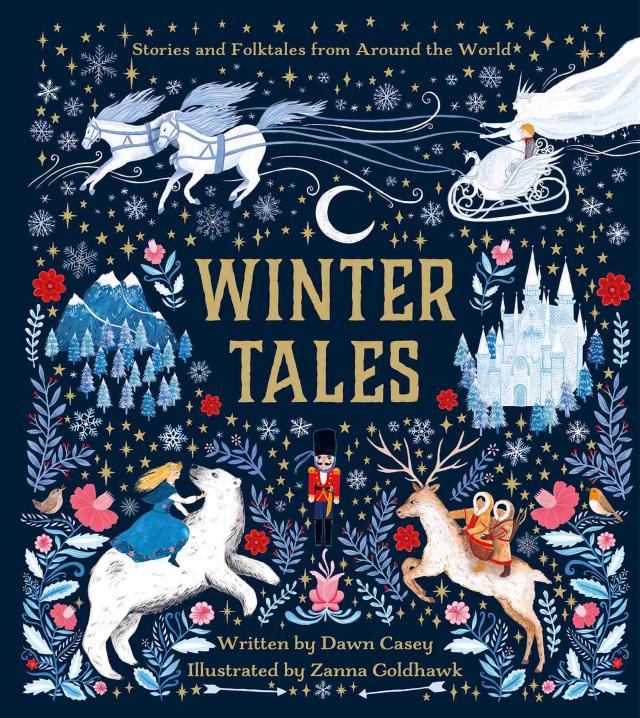


Croaking ravens flew through the open walls of the robbers’ tumbledown castle. Gerda and the robber girl slept on the earth, in straw that smelled of summer. The robber girl asked Gerda question after question, and Gerda shared her story. While she spoke, the woodpigeons in the rafters called to her. “Coo-coo, we have seen Kay, riding in the Snow Queen’s sleigh…”
“Then I must go!” Gerda sprung to her feet. The robber girl looked at Gerda with her head to one side. “You’re not so timid, after all.” She gave Gerda back her boots. “You’ll need these. And here, take him…” Tethered to the wall was a reindeer, a bright copper ring around his neck. Gerda clung onto his antlers as he lurched away, and she turned, waving farewell to the girl.
Together they leapt over moors and marshes, they rode through dark woods and valleys of shining snow. They followed the North Star to the top of the world—to Finland—where they came across a humble hut where an old woman lived. “Yes, I know the way to the Snow Queen’s castle,” said the woman. “And I know a wise woman in Lapland who might help you…”
On they rode, farther north, to Lapland. There they found the wise woman. The reindeer looked at her with such pleading eyes that her own eyes twinkled. “Don’t you see?” she said to the reindeer. “I can give Gerda no greater power than the power of her own heart. If she cannot free Kay, we cannot help her. Carry her to where the Snow Queen’s garden begins. Put her down by the bush with the red berries.”
Before long, they came to the red-berried bush standing in the snow, and the reindeer set Gerda down. She kissed his velvet nose, and he galloped away.
Like darts, an army of snowflakes came spinning toward her. Gerda joined her hands and she prayed. She prayed and she prayed and her warm breath steamed from her mouth in billowing clouds. The clouds shifted and grew, they became white angels, circling Gerda in a ring of protection.
In awe, Gerda stared up at the crystal castle of the Snow Queen. Spiked ice spires pierced the sky. The walls of the castle were driven snow, the windows, cutting wind. White walls glittered and glowed blue-green in the fire of the Northern Lights. The palace was beautiful, but it was cold and bare. There were never any gatherings or celebrations here, not even a little bear’s ball, where the wind might make music and the polar bears might show off their grand manners.
Gerda crept through the great gates, hardly daring to breathe. She crept through the ice-halls to the heart of the castle. There was a frozen lake, like a dark mirror. There was Kay! And, towering above him, stood the Snow Queen. Gerda pressed herself to the wall and watched, her heart beating with hope and fear. With a swirl of her cloak, the Snow Queen leapt into her silver sleigh and flew off to powder the mountaintops with snow. Gerda shivered and let out a shudder of breath, as the shadow of the sleigh swept over her head, leaving Kay alone on the ice.
“Kay! Kay!” Gerda ran and flung her arms around his neck. But Kay sat unmoved. He did not recognize her. His fingers were stiff with cold. “Kay? Kay!” Gerda wept and wept. Hot tears poured down her cheeks and onto Kay’s face. Kay blinked. He blinked again. “Gerda?” Her warm tears had melted the ice in his heart. Kay’s own tears began to flow now, warm and clean, washing away the splinter from his eye.Then Gerda and Kay were hugging and crying and laughing, all at once. Even the shards of ice danced for joy. And when they lay still again, they formed a word: eternity.
Hand in hand, Gerda and Kay left the castle of the Snow Queen behind them. At the bush with the red berries, there was the faithful reindeer, waiting for them.
The robber girl, in her bright red cap, sat astride the horse. “I was tired of staying at home. I’m going north or, if that doesn’t suit me, somewhere else. Farewell!” And she rode out into the wide world. Gerda and Kay traveled south on the reindeer’s back, calling out their thanks to all who had helped them on their way.
At last, they came to the city of high steeples and ringing bells, where Grandma threw her arms around them. “You’re safe! You’re home!” Up on the rooftop garden, the roses opened their petals and bloomed.
RABBIT’S GIFT
A folktale from China
In some parts of Northern China, it is so cold, for so long, that when snow falls it stays frozen, and over the winter months the snow grows deeper and deeper with every snowfall. It is an old tradition in Northern China for families to stock up on staple foods, such as cabbage and turnip at the start of the cold season, to keep the whole family well-fed all winter. An old Chinese proverb says: “Eat ginger in summer, eat turnip in winter, and there’s no need for the doctor.” (The vegetable known in China as the winter turnip is known in Western countries as the daikon radish.)
On the peaks of Cold Mountain, the forests were breathing out mist. The old path went winding into white cloud. In the fields, the thatch huts were robed with snow.
An ancient plum tree stood knotted and gnarled, battered by the wind. Deep in the roots of the tree lived a rabbit. He was hungry.
So, he hopped out of his hole to look for something to eat. He dug away the sparkling snow with his paws and there he found two winter turnips. They were long and muddy-white, with a froth of pale leaves.
He ate one of the turnips. It gave a satisfying snap between his teeth and was hot like pepper on his tongue. Mmm, it was good. But when he came to the second turnip, he felt full. “I know,” said Rabbit. “I’ll give this turnip to dear old Donkey.” So off he hopped through the snow.
But when Rabbit found Donkey’s old wooden plough, it was covered in snow, and Donkey wasn’t there. “I’ll leave the turnip here for him,” he said.
Rabbit hopped back home to his warm burrow. He curled up tight, a ball of soft fur, and fell asleep smiling, thinking of the lovely surprise he had given to his dear old friend.
Donkey was looking for food. He couldn’t reach the dry stalks hidden deep under the snow. He trotted here and there looking for something to eat. Before long, Donkey found a wrinkled crab apple hanging from a crooked branch. Crunch! Munch! He ate the apple in two big bites. Mmm, it was good.
When Donkey got back to his old wooden plough, what did he find but a winter turnip. ”Well,” he said to himself, “I wonder how that got there?”
But Donkey was already full. He thought of his friend Sheep. “The snow is so deep, perhaps Sheep can’t reach the grass. I know…”
Donkey rolled the turnip along with his nose, leaving a wavering trail in the snow. But when he got to the clump of trees where Sheep liked to shelter, she wasn’t there. “I’ll leave it here for her,” he said.
Farther on down the way, Sheep was looking for food. She plodded here and there looking for something to eat. Before long, she found a cabbage. The outside leaves were a little brown, but the inside was firm and crisp. Sheep ate the cabbage all up. Mmm, it was good.
When Sheep got back to her clump of trees, what did she find, but a winter turnip. “Well,” she said to herself, “I wonder how that got there?”
But Sheep was full. “I know,” she said. “I’ll give this turnip to Deer.” So off she went, carrying the turnip in her teeth, leaving a little row of peg-prints dotted in the snow.
Sheep walked up the rocky mountain. At the edge of the forest, she followed the track through the undergrowth and found a flat deerbed in a dense thicket. But Deer wasn’t there. “I’ll leave the turnip here for her.”
Deer was browsing—scraping through the snow looking for grass. She didn’t find any grasses, but she did find a young pine tree. Mmm, the pine tasted cool and clean.
When Deer got back to her den, what did she find on her bed, but a winter turnip. “Well,” she said to herself, “I wonder how that got there?”
Deer was full. “I know,” she said. “I’ll give this turnip to a friend,a dear old friend…”
So off she went down the mountain, through the forest and over the fields, all the way to the old plum tree. Deer peeped her head into Rabbit’s burrow, but Rabbit was fast asleep. So, Deer left the turnip by his side and crept quietly away.
Rabbit yawned and stretched. It had been a good nap. But now he felt hungry again. “Hmmm… I wish I had a turnip,” he said.
Rabbit opened his eyes. And what did he see, but a winter turnip!
“Well!” said Rabbit. “A gift for me! I wonder how that got there…” And he ate that winter turnip all up. Mmm, it was good.
THE CHILDREN AND THE SUN
A folktale from the Kalahari Desert, Southern Africa
On December 21, it is the winter solstice—the turning point of the year. From autumn onwards, the days grow shorter and darker. After December 21, the hours of daylight increase again. Since ancient times, people all over the world have recognized the importance of the solstice and have celebrated the “return” of the sun in many ways. This tale from the San people of southern Africa's great Kalahari Desert tells of a time when the earth was always winter-dark and celebrates the first time that the sun shone in the sky.
Here is a story, from the Kalahari Desert, a land of red earth and dry sand. For countless years, the life of the people of the Kalahari was unchanging. Children rose early to fill their flasks with water and to gather wild cucumbers and melons.Little ones went out with their mothers, picking nuts and nin berries. Men sunned their shoulder blades, hunting antelope and ostrich.
But, it was not always so. In the time of the First People, there was no sun up in the sky. It was always cold and gloom-gray, like an endless winter’s night when the desert air freezes and frost forms on the brown plants.
There were three boys living then: Kabbo, Karu, and Kau. Kabbo was the eldest, Karu was his brother, and their friend Kau was the littlest one.
One day, they were playing ball with a wild melon; small and round and yellow. Kabbo threw it high in the air. Karu squinted his eyes and reached out his hands. Boof! The melon landed in the sand. Karu frowned. “I can’t see!” And he kicked the ball away. The melon went bouncing and rolling through the gloom towards an old man, lying slumped by himself at the edge of the village, snoring.
Bump! The ball rolled right into the sleeping man. “Huh?” He sat up, and he stretched. And as he raised his arms, light shone from out of his body! Hot, bright, radiant light! The children stared at him in awe.
“Grandfather,” said Kabbo, “you have light within you!” The old man snapped his arms shut, and the world shrank back to darkness. “Grandfather,” said Kabbo, “open your arms again!”
The old man glared. “It would burn you like fire! Get away!”
“Grandfather,” said Karu, “please share your light.”
“Away, I said!” the old man growled.
“Grandfather,” said Kau, “please.”
The old man scowled at the children. He turned his back and curled up tight.
There was a white-haired woman in the boys’ village who had lived and lived, and now she was very old and she knew many things. The children went to her hut.
“Grandmother, help us,” said Kabbo. “That old man there has light within him!But he is all closed up. What can we do?”
The old woman sat quite still, listening to the wisdom within her body.She looked at the children’s ball. She grinned. Then she called the mothers of the village together. The young ones crowded around. The old woman announced, “These children are going to help that old man. They are going to help us all. The children will throw that old man up into the sky to make the sun!”
The women’s faces crinkled with laughter. “Heh, heh!”
The children stood with mouths agape.
“Eh, hey! We cannot do that!”
“He is too heavy!”
“He is too hot!”
“You can,” said the old woman. “Together.” Then she said no more.
Later, the children found the old man sitting hunched outside his grass hut, all alone. They hid; watching and waiting. After a while, the man let out a giant yawn and closed his eyes. Slowly, stealthily, the children stalked up to him.
Wink! One eye flicked open! The children froze. The old man turned over. The children crept closer…
Blink! Two eyes flashed open! The children held their breath. He settled back down. The children crept closer, closer…
Nod! His head nodded, and he began to snore. His arms flopped to his sides;burning light blazed out of him. The children stared in awe.
“Can we?” asked Kabbo.
“I don’t know,” said Karu.
“I’m scared,” said Kau.
The children remembered the old woman’s words and her words made their hearts brave, like the leopard’s heart. Kabbo took hold of the old man’s shoulders. Karu took hold of the old man’s legs. Kau took a pinch of buchu herb. He rubbed the leaves so the soothing scent rose to the old man’s nose. The old man breathed deep, and he smiled in his sleep.
“Hold him tight!” whispered Kabbo.
“Lift him up!” whispered Karu.
“Throw him up!” they all called together, and with a great heave the children threw that old man, the sun, high up into the sky.
The sun-man went spinning through the skies. His eyes were wide with surprise. The children called up to him, shouting:
Oh, Grandfather, become the sun!
Be hot! Make the whole Earth warm!
Be bright! Make the whole Earth light!
Shine! Chase away the darkness!
And as the sun flew higher, the sky brightened, and yellow sunshine lit up the land. From way up high that old man, the sun, could see the whole world below him, all glorying in his light; all the people basking in his warmth. He saw the old people warming their backs and easing their bones. He saw the women smiling up their thanks, as they set out their clay pots to dry. He saw the men hunting, taking perfect aim. He saw the children smiling and waving. And the sun began to smile. His light shone brighter and brighter within him, until his whole being was smiling and shining.
That evening, for the first time ever, the sun set. The people sang. The women clapped their hands. The men danced, danced, danced. They danced in celebration of the sun. The children beamed with delight. And as time passed, the sun’s light shone in every direction, and he grew round.
Now, that story is finished; it drifts away with the wind. But up in the sky, the sun is still here, even in the heart of winter.
THE TWELVE MONTHS
A folktale from Greece
This folktale is well-known in northern Slavic lands, such as Russia, Bohemia, Moravia, and Slovakia. This version, though, comes from Greece. In Northern Greece, up in the mountains, winter brings the snow. High on the peaks of Mount Olympus, the tallest mountain in the land, it often snows all winter long.
Once, there were two neighbors who were both widows. Each one had a daughter. The first daughter, Marianna, helped her mother to bake and cook and wash and sew and spin. She helped take care of the garden and look after the cows. The neighbor’s daughter, Helena, never dirtied her hands with work. She sat all day in the chimney corner, adorning herself with trinkets.
Marianna saw how hard her mother worked and how little food they had. One winter’s day, she trudged out into the thick snow to gather kindling for the fire. Deep in the frozen forest, she stretched up to reach the fallen twigs caught in the forks of the branches. They would make a good fire. Up ahead, she could see something. A light…
There, in a clearing, was a circle of low stones and in the center a fire blazed. Twelve figures were sitting on the stones around the fire.
“Excuse me,” said Marianna. “Please, may I warm myself by your fire, just for a moment?” An old man, with a long white beard like a tangle of fluffy seeds, smiled at her. His blue eyes twinkled.
“Of course,” said Great January, for that was who the old man was; the twelve figures were the twelve months of the year. Marianna reached her fingers towards the flames. “And perhaps,” he said, “you can offer your thoughts to our discussion. Tell me, what do you think of the twelve months? What do you think of, say, March?”
“Oh, March! I love spring. Yellow flowers opening their hearts to the sun, lifting my spirits. That unbelievable green! And oh…” Marianna touched her cheek. “The first time the breeze feels gentle and warm. And the smell of the earth after the rain.”
“And what of May?” asked a young woman in a frock of green, a circlet of white flowers woven into her hair. How pretty she was!
“Ah, May…” The girl sighed. “May is so lovely! Waking to the sound of birdsong… Waves of white blossom… Daisy chains and dandelion wishes! Oh, I love May.”
The old man nodded, smiling to himself. “What of June, then?” A woman with a dress of delicate pink, like wild rose petals, turned her head to listen to her answer.
“Mmm, June… Such lusciousness! Raspberries and roses… The scent of honeysuckle in the warm evening. Oh, June is a pleasure.”
“And what of August?” asked an older woman. She was round and plump, with ruddy cheeks and a linen apron worn soft with age. The girl thought she could smell the scent of fresh baked bread about her.
“Mmm, August… Everything warm and mellow and golden. Trailing toes in rippling water… Sunlit leaves and drowsy bees… I love August.”
The man next to the stout woman stood up. His breeches were beech-brown, and his velvet waistcoat was tawny-gold. “And September?”
“Oh, autumn… the harvest! Red apples and ripe berries… Crunching yellow leaves. The first nip in the air that makes the fireside evenings welcome.”
“What of winter, then?” asked the old man. “Winter does not offer such riches.”
“Oh, winter!” said the girl. “Winter is the most wonderful of all! There’s a purity, somehow, to the bare earth and the clear shapes of the trees… a quiet beauty. And the cold is fresh and true—it makes me feel alive. After all the busy work of summer and autumn, we can be still and rest. Thank goodness for winter.”
“Then I must go!” Gerda sprung to her feet. The robber girl looked at Gerda with her head to one side. “You’re not so timid, after all.” She gave Gerda back her boots. “You’ll need these. And here, take him…” Tethered to the wall was a reindeer, a bright copper ring around his neck. Gerda clung onto his antlers as he lurched away, and she turned, waving farewell to the girl.
Together they leapt over moors and marshes, they rode through dark woods and valleys of shining snow. They followed the North Star to the top of the world—to Finland—where they came across a humble hut where an old woman lived. “Yes, I know the way to the Snow Queen’s castle,” said the woman. “And I know a wise woman in Lapland who might help you…”
On they rode, farther north, to Lapland. There they found the wise woman. The reindeer looked at her with such pleading eyes that her own eyes twinkled. “Don’t you see?” she said to the reindeer. “I can give Gerda no greater power than the power of her own heart. If she cannot free Kay, we cannot help her. Carry her to where the Snow Queen’s garden begins. Put her down by the bush with the red berries.”
Before long, they came to the red-berried bush standing in the snow, and the reindeer set Gerda down. She kissed his velvet nose, and he galloped away.
Like darts, an army of snowflakes came spinning toward her. Gerda joined her hands and she prayed. She prayed and she prayed and her warm breath steamed from her mouth in billowing clouds. The clouds shifted and grew, they became white angels, circling Gerda in a ring of protection.
In awe, Gerda stared up at the crystal castle of the Snow Queen. Spiked ice spires pierced the sky. The walls of the castle were driven snow, the windows, cutting wind. White walls glittered and glowed blue-green in the fire of the Northern Lights. The palace was beautiful, but it was cold and bare. There were never any gatherings or celebrations here, not even a little bear’s ball, where the wind might make music and the polar bears might show off their grand manners.
Gerda crept through the great gates, hardly daring to breathe. She crept through the ice-halls to the heart of the castle. There was a frozen lake, like a dark mirror. There was Kay! And, towering above him, stood the Snow Queen. Gerda pressed herself to the wall and watched, her heart beating with hope and fear. With a swirl of her cloak, the Snow Queen leapt into her silver sleigh and flew off to powder the mountaintops with snow. Gerda shivered and let out a shudder of breath, as the shadow of the sleigh swept over her head, leaving Kay alone on the ice.
“Kay! Kay!” Gerda ran and flung her arms around his neck. But Kay sat unmoved. He did not recognize her. His fingers were stiff with cold. “Kay? Kay!” Gerda wept and wept. Hot tears poured down her cheeks and onto Kay’s face. Kay blinked. He blinked again. “Gerda?” Her warm tears had melted the ice in his heart. Kay’s own tears began to flow now, warm and clean, washing away the splinter from his eye.Then Gerda and Kay were hugging and crying and laughing, all at once. Even the shards of ice danced for joy. And when they lay still again, they formed a word: eternity.
Hand in hand, Gerda and Kay left the castle of the Snow Queen behind them. At the bush with the red berries, there was the faithful reindeer, waiting for them.
The robber girl, in her bright red cap, sat astride the horse. “I was tired of staying at home. I’m going north or, if that doesn’t suit me, somewhere else. Farewell!” And she rode out into the wide world. Gerda and Kay traveled south on the reindeer’s back, calling out their thanks to all who had helped them on their way.
At last, they came to the city of high steeples and ringing bells, where Grandma threw her arms around them. “You’re safe! You’re home!” Up on the rooftop garden, the roses opened their petals and bloomed.
RABBIT’S GIFT
A folktale from China
In some parts of Northern China, it is so cold, for so long, that when snow falls it stays frozen, and over the winter months the snow grows deeper and deeper with every snowfall. It is an old tradition in Northern China for families to stock up on staple foods, such as cabbage and turnip at the start of the cold season, to keep the whole family well-fed all winter. An old Chinese proverb says: “Eat ginger in summer, eat turnip in winter, and there’s no need for the doctor.” (The vegetable known in China as the winter turnip is known in Western countries as the daikon radish.)
On the peaks of Cold Mountain, the forests were breathing out mist. The old path went winding into white cloud. In the fields, the thatch huts were robed with snow.
An ancient plum tree stood knotted and gnarled, battered by the wind. Deep in the roots of the tree lived a rabbit. He was hungry.
So, he hopped out of his hole to look for something to eat. He dug away the sparkling snow with his paws and there he found two winter turnips. They were long and muddy-white, with a froth of pale leaves.
He ate one of the turnips. It gave a satisfying snap between his teeth and was hot like pepper on his tongue. Mmm, it was good. But when he came to the second turnip, he felt full. “I know,” said Rabbit. “I’ll give this turnip to dear old Donkey.” So off he hopped through the snow.
But when Rabbit found Donkey’s old wooden plough, it was covered in snow, and Donkey wasn’t there. “I’ll leave the turnip here for him,” he said.
Rabbit hopped back home to his warm burrow. He curled up tight, a ball of soft fur, and fell asleep smiling, thinking of the lovely surprise he had given to his dear old friend.
Donkey was looking for food. He couldn’t reach the dry stalks hidden deep under the snow. He trotted here and there looking for something to eat. Before long, Donkey found a wrinkled crab apple hanging from a crooked branch. Crunch! Munch! He ate the apple in two big bites. Mmm, it was good.
When Donkey got back to his old wooden plough, what did he find but a winter turnip. ”Well,” he said to himself, “I wonder how that got there?”
But Donkey was already full. He thought of his friend Sheep. “The snow is so deep, perhaps Sheep can’t reach the grass. I know…”
Donkey rolled the turnip along with his nose, leaving a wavering trail in the snow. But when he got to the clump of trees where Sheep liked to shelter, she wasn’t there. “I’ll leave it here for her,” he said.
Farther on down the way, Sheep was looking for food. She plodded here and there looking for something to eat. Before long, she found a cabbage. The outside leaves were a little brown, but the inside was firm and crisp. Sheep ate the cabbage all up. Mmm, it was good.
When Sheep got back to her clump of trees, what did she find, but a winter turnip. “Well,” she said to herself, “I wonder how that got there?”
But Sheep was full. “I know,” she said. “I’ll give this turnip to Deer.” So off she went, carrying the turnip in her teeth, leaving a little row of peg-prints dotted in the snow.
Sheep walked up the rocky mountain. At the edge of the forest, she followed the track through the undergrowth and found a flat deerbed in a dense thicket. But Deer wasn’t there. “I’ll leave the turnip here for her.”
Deer was browsing—scraping through the snow looking for grass. She didn’t find any grasses, but she did find a young pine tree. Mmm, the pine tasted cool and clean.
When Deer got back to her den, what did she find on her bed, but a winter turnip. “Well,” she said to herself, “I wonder how that got there?”
Deer was full. “I know,” she said. “I’ll give this turnip to a friend,a dear old friend…”
So off she went down the mountain, through the forest and over the fields, all the way to the old plum tree. Deer peeped her head into Rabbit’s burrow, but Rabbit was fast asleep. So, Deer left the turnip by his side and crept quietly away.
Rabbit yawned and stretched. It had been a good nap. But now he felt hungry again. “Hmmm… I wish I had a turnip,” he said.
Rabbit opened his eyes. And what did he see, but a winter turnip!
“Well!” said Rabbit. “A gift for me! I wonder how that got there…” And he ate that winter turnip all up. Mmm, it was good.
THE CHILDREN AND THE SUN
A folktale from the Kalahari Desert, Southern Africa
On December 21, it is the winter solstice—the turning point of the year. From autumn onwards, the days grow shorter and darker. After December 21, the hours of daylight increase again. Since ancient times, people all over the world have recognized the importance of the solstice and have celebrated the “return” of the sun in many ways. This tale from the San people of southern Africa's great Kalahari Desert tells of a time when the earth was always winter-dark and celebrates the first time that the sun shone in the sky.
Here is a story, from the Kalahari Desert, a land of red earth and dry sand. For countless years, the life of the people of the Kalahari was unchanging. Children rose early to fill their flasks with water and to gather wild cucumbers and melons.Little ones went out with their mothers, picking nuts and nin berries. Men sunned their shoulder blades, hunting antelope and ostrich.
But, it was not always so. In the time of the First People, there was no sun up in the sky. It was always cold and gloom-gray, like an endless winter’s night when the desert air freezes and frost forms on the brown plants.
There were three boys living then: Kabbo, Karu, and Kau. Kabbo was the eldest, Karu was his brother, and their friend Kau was the littlest one.
One day, they were playing ball with a wild melon; small and round and yellow. Kabbo threw it high in the air. Karu squinted his eyes and reached out his hands. Boof! The melon landed in the sand. Karu frowned. “I can’t see!” And he kicked the ball away. The melon went bouncing and rolling through the gloom towards an old man, lying slumped by himself at the edge of the village, snoring.
Bump! The ball rolled right into the sleeping man. “Huh?” He sat up, and he stretched. And as he raised his arms, light shone from out of his body! Hot, bright, radiant light! The children stared at him in awe.
“Grandfather,” said Kabbo, “you have light within you!” The old man snapped his arms shut, and the world shrank back to darkness. “Grandfather,” said Kabbo, “open your arms again!”
The old man glared. “It would burn you like fire! Get away!”
“Grandfather,” said Karu, “please share your light.”
“Away, I said!” the old man growled.
“Grandfather,” said Kau, “please.”
The old man scowled at the children. He turned his back and curled up tight.
There was a white-haired woman in the boys’ village who had lived and lived, and now she was very old and she knew many things. The children went to her hut.
“Grandmother, help us,” said Kabbo. “That old man there has light within him!But he is all closed up. What can we do?”
The old woman sat quite still, listening to the wisdom within her body.She looked at the children’s ball. She grinned. Then she called the mothers of the village together. The young ones crowded around. The old woman announced, “These children are going to help that old man. They are going to help us all. The children will throw that old man up into the sky to make the sun!”
The women’s faces crinkled with laughter. “Heh, heh!”
The children stood with mouths agape.
“Eh, hey! We cannot do that!”
“He is too heavy!”
“He is too hot!”
“You can,” said the old woman. “Together.” Then she said no more.
Later, the children found the old man sitting hunched outside his grass hut, all alone. They hid; watching and waiting. After a while, the man let out a giant yawn and closed his eyes. Slowly, stealthily, the children stalked up to him.
Wink! One eye flicked open! The children froze. The old man turned over. The children crept closer…
Blink! Two eyes flashed open! The children held their breath. He settled back down. The children crept closer, closer…
Nod! His head nodded, and he began to snore. His arms flopped to his sides;burning light blazed out of him. The children stared in awe.
“Can we?” asked Kabbo.
“I don’t know,” said Karu.
“I’m scared,” said Kau.
The children remembered the old woman’s words and her words made their hearts brave, like the leopard’s heart. Kabbo took hold of the old man’s shoulders. Karu took hold of the old man’s legs. Kau took a pinch of buchu herb. He rubbed the leaves so the soothing scent rose to the old man’s nose. The old man breathed deep, and he smiled in his sleep.
“Hold him tight!” whispered Kabbo.
“Lift him up!” whispered Karu.
“Throw him up!” they all called together, and with a great heave the children threw that old man, the sun, high up into the sky.
The sun-man went spinning through the skies. His eyes were wide with surprise. The children called up to him, shouting:
Oh, Grandfather, become the sun!
Be hot! Make the whole Earth warm!
Be bright! Make the whole Earth light!
Shine! Chase away the darkness!
And as the sun flew higher, the sky brightened, and yellow sunshine lit up the land. From way up high that old man, the sun, could see the whole world below him, all glorying in his light; all the people basking in his warmth. He saw the old people warming their backs and easing their bones. He saw the women smiling up their thanks, as they set out their clay pots to dry. He saw the men hunting, taking perfect aim. He saw the children smiling and waving. And the sun began to smile. His light shone brighter and brighter within him, until his whole being was smiling and shining.
That evening, for the first time ever, the sun set. The people sang. The women clapped their hands. The men danced, danced, danced. They danced in celebration of the sun. The children beamed with delight. And as time passed, the sun’s light shone in every direction, and he grew round.
Now, that story is finished; it drifts away with the wind. But up in the sky, the sun is still here, even in the heart of winter.
THE TWELVE MONTHS
A folktale from Greece
This folktale is well-known in northern Slavic lands, such as Russia, Bohemia, Moravia, and Slovakia. This version, though, comes from Greece. In Northern Greece, up in the mountains, winter brings the snow. High on the peaks of Mount Olympus, the tallest mountain in the land, it often snows all winter long.
Once, there were two neighbors who were both widows. Each one had a daughter. The first daughter, Marianna, helped her mother to bake and cook and wash and sew and spin. She helped take care of the garden and look after the cows. The neighbor’s daughter, Helena, never dirtied her hands with work. She sat all day in the chimney corner, adorning herself with trinkets.
Marianna saw how hard her mother worked and how little food they had. One winter’s day, she trudged out into the thick snow to gather kindling for the fire. Deep in the frozen forest, she stretched up to reach the fallen twigs caught in the forks of the branches. They would make a good fire. Up ahead, she could see something. A light…
There, in a clearing, was a circle of low stones and in the center a fire blazed. Twelve figures were sitting on the stones around the fire.
“Excuse me,” said Marianna. “Please, may I warm myself by your fire, just for a moment?” An old man, with a long white beard like a tangle of fluffy seeds, smiled at her. His blue eyes twinkled.
“Of course,” said Great January, for that was who the old man was; the twelve figures were the twelve months of the year. Marianna reached her fingers towards the flames. “And perhaps,” he said, “you can offer your thoughts to our discussion. Tell me, what do you think of the twelve months? What do you think of, say, March?”
“Oh, March! I love spring. Yellow flowers opening their hearts to the sun, lifting my spirits. That unbelievable green! And oh…” Marianna touched her cheek. “The first time the breeze feels gentle and warm. And the smell of the earth after the rain.”
“And what of May?” asked a young woman in a frock of green, a circlet of white flowers woven into her hair. How pretty she was!
“Ah, May…” The girl sighed. “May is so lovely! Waking to the sound of birdsong… Waves of white blossom… Daisy chains and dandelion wishes! Oh, I love May.”
The old man nodded, smiling to himself. “What of June, then?” A woman with a dress of delicate pink, like wild rose petals, turned her head to listen to her answer.
“Mmm, June… Such lusciousness! Raspberries and roses… The scent of honeysuckle in the warm evening. Oh, June is a pleasure.”
“And what of August?” asked an older woman. She was round and plump, with ruddy cheeks and a linen apron worn soft with age. The girl thought she could smell the scent of fresh baked bread about her.
“Mmm, August… Everything warm and mellow and golden. Trailing toes in rippling water… Sunlit leaves and drowsy bees… I love August.”
The man next to the stout woman stood up. His breeches were beech-brown, and his velvet waistcoat was tawny-gold. “And September?”
“Oh, autumn… the harvest! Red apples and ripe berries… Crunching yellow leaves. The first nip in the air that makes the fireside evenings welcome.”
“What of winter, then?” asked the old man. “Winter does not offer such riches.”
“Oh, winter!” said the girl. “Winter is the most wonderful of all! There’s a purity, somehow, to the bare earth and the clear shapes of the trees… a quiet beauty. And the cold is fresh and true—it makes me feel alive. After all the busy work of summer and autumn, we can be still and rest. Thank goodness for winter.”






