

Rebel, p.1
Rebel, page 1


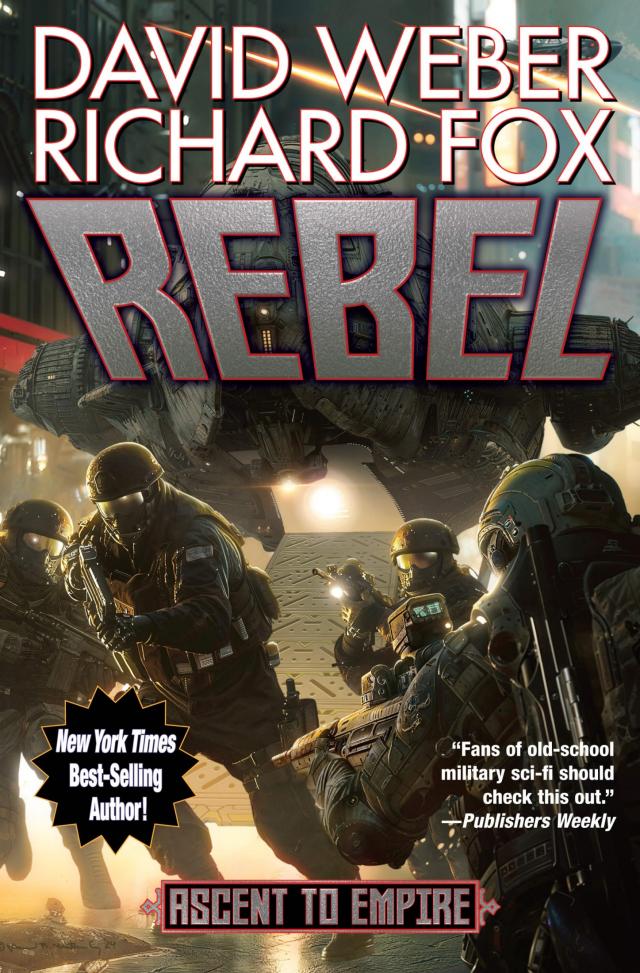
Table of Contents
CHAPTER ONE
CHAPTER TWO
CHAPTER THREE
CHAPTER FOUR
CHAPTER FIVE
CHAPTER SIX
CHAPTER SEVEN
CHAPTER EIGHT
CHAPTER NINE
CHAPTER TEN
CHAPTER ELEVEN
CHAPTER TWELVE
CHAPTER THIRTEEN
CHAPTER FOURTEEN
CHAPTER FIFTEEN
CHAPTER SIXTEEN
CHAPTER SEVENTEEN
CHAPTER EIGHTEEN
CHAPTER NINETEEN
CHAPTER TWENTY
CHAPTER TWENTY-ONE
CHAPTER TWENTY-TWO
CHAPTER TWENTY-THREE
CHAPTER TWENTY-FOUR
CHAPTER TWENTY-FIVE
CHAPTER TWENTY-SIX
CHAPTER TWENTY-SEVEN
CHAPTER TWENTY-EIGHT
CHAPTER TWENTY-NINE
CHAPTER THIRTY
CHAPTER THIRTY-ONE
CHAPTER THIRTY-TWO
CHAPTER THIRTY-THREE
CHAPTER THIRTY-FOUR
CHAPTER THIRTY-FIVE
CHAPTER THIRTY-SIX
CHAPTER THIRTY-SEVEN
CHAPTER THIRTY-EIGHT
CHAPTER THIRTY-NINE
CHAPTER FORTY
CHAPTER FORTY-ONE
CHAPTER FORTY-TWO
CHAPTER FORTY-THREE
CHAPTER FORTY-FOUR
Rebel
by David Weber and Richard Fox
Book two in David Weber and Richard Fox’s Ascent to Empire series.
HE NEVER WANTED TO BE A REBEL
The Five Hundred, the elite families who rule the Terran Federation, control its political power and its wealth, and they’ve grown steadily wealthier and more powerful, thanks to the war against the Terran League. War may be hard on the people who get caught in its path, but it’s very good for business, in the short term, and the Five Hundred own the shipyards that build the Navy’s ships. They own virtually all the industry that produces the weapons and matériel the war consumes so voraciously . . . and they’ve made damn sure someone else does the dying.
True, there are a few flies in the Five Hundred’s ointment.
There’s the growing hatred and resentment of the Fringe Worlds, whose children do eighty percent of the dying in the Five Hundred’s war. But the Five Hundred have made sure the Fringe knows what will happen to any system that goes ”out of compliance.”
There are the lunatic conspiracy nuts who insist that the alien Rishathan Sphere is secretly aiding the League’s military, but the Five Hundred have forced them to keep their mouths shut where it matters.
And then there’s Terrence Murphy, a man of honor who loves the Federation, who springs from the Five Hundred, yet knows it for what it is and is determined to speak for its victims. But the five hundred have dispatched ample force to deal with him and his handful of lunatic followers.
Unfortunately, the Fringe has paid enough of its children’s lives, and it no longer cares what may happen if it dares to defy the Five Hundred.
Worse, the lunatic conspiracy nuts were right, and the Rish have planned carefully for the Federation’s destruction.
And, worst of all, the Five Hundred have fatally underestimated Terrence Murphy.
BAEN BOOKS by DAVID WEBER and RICHARD FOX
ASCENT TO EMPIRE
Governor
Rebel
BAEN BOOKS by DAVID WEBER
HONOR HARRINGTON
On Basilisk Station • The Honor of the Queen
The Short Victorious War • Field of Dishonor • Flag in Exile
Honor Among Enemies • In Enemy Hands • Echoes of Honor
Ashes of Victory • War of Honor • At All Costs
Mission of Honor • Crown of Slaves with Eric Flint
Torch of Freedom with Eric Flint • The Shadow of Saganami
Storm from the Shadows • A Rising Thunder
Shadow of Freedom • Cauldron of Ghosts with Eric Flint
Shadow of Victory • Uncompromising Honor
EXPANDED HONOR: Toll of Honor
WORLDS OF HONOR, edited by David Weber: More than Honor • Worlds of Honor
Changer of Worlds • The Service of the Sword
In Fire Forged • Beginnings • What Price Victory?
MANTICORE ASCENDANT: A Call to Duty with Timothy Zahn
A Call to Arms with Timothy Zahn & Tom Pope
A Call to Vengeance with Timothy Zahn & Tom Pope
A Call to Insurrection with Timothy Zahn & Tom Pope
THE STAR KINGDOM:
A Beautiful Friendship • Fire Season with Jane Lindskold
Treecat Wars with Jane Lindskold • A New Clan with Jane Lindskold
Friends Indeed with Jane Lindskold (forthcoming)
House of Steel: The Honorverse Companion with BuNine
GORDIAN DIVISION SERIES
The Gordian Division with Jacob Holo
The Valkyrie Protocol with Jacob Holo
The Janus File with Jacob Holo
The Weltall File with Jacob Holo
The Dyson File by Jacob Holo
The Thermopylae Protocol with Jacob Holo
MULTIVERSE SERIES
Hell’s Gate with Linda Evans
Hell Hath No Fury with Linda Evans
The Road to Hell with Joelle Presby
Rebel
This is a work of fiction. All the characters and events portrayed in this book are fictional, and any resemblance to real people or incidents is purely coincidental.
Copyright © 2024 by Words of Weber, Inc. and Richard Fox
All rights reserved, including the right to reproduce this book or portions thereof in any form.
A Baen Books Original
Baen Publishing Enterprises
P.O. Box 1403
Riverdale, NY 10471
www.baen.com
ISBN: 978-1-9821-9360-7
eISBN: 978-1-625799-82-1
Cover art by David Mattingly
First printing, September 2024
Distributed by Simon & Schuster
1230 Avenue of the Americas
New York, NY 10020
Library of Congress Cataloging-in-Publication Data
Names: Weber, David, 1952– author. | Fox, Richard, 1978– author.
Title: Rebel / David Weber & Richard Fox.
Description: Riverdale, NY : Baen Publishing Enterprises, 2024. | Series: Ascent to Empire ; 2
Identifiers: LCCN 2024019307 (print) | LCCN 2024019308 (ebook) | ISBN 9781982193607 (hardcover) | ISBN 9781625799821 (ebook)
Subjects: LCGFT: Science fiction. | Novels.
Classification: LCC PS3573.E217 R43 2024 (print) | LCC PS3573.E217 (ebook) | DDC 813/.54—dc23/eng/20240506
LC record available at https://lccn.loc.gov/2024019307
LC ebook record available at https://lccn.loc.gov/2024019308
Printed in the United States of America
10 9 8 7 6 5 4 3 2 1
Electronic version by Baen Books
www.baen.com
For Master Sergeant Terry Murphy, a cancer survivor who gave the U.S. Air Force twenty-two years of his life and me sixty years of friendship and love.
—D.W.
For Professor Elizabeth Samet.
Thank you for the library.
—R.F.
How it began…
The Great Eastern War, sparked by the Taiwan Crisis of 2057, kills 43,000,000 people. Deserted by all but a handful of its allies/client states, the Communist Party loses its internal mandate and is replaced with a façade democracy, which the rest of the world refuses to accept as a genuinely representative government.
In 2059, the Federated Government of Earth is created, intended as a multi-continental federal system, not a consultative body. As a major, deliberately unifying project recalling the twentieth century “race to the Moon,” the FGE commits to achieving interstellar flight. China, which sees the invitation to join the FGE as an effort to further subordinate it, rejects membership but commits to its own, independent interstellar flight program as part of its assertion of continued political, scientific, and economic power.
In 2082, the first FGE-sponsored Bussard RAIR (Ram Augmented Interstellar Rocket) departs the Solar System for the stars. Additional state and privately sponsored expeditions follow.
In 2086, China launches its first state-sponsored generation colony ship. Whereas FGE-sponsored expeditions are deliberately multi-ethnic, Chinese colony expeditions (like many privately sponsored FGE expeditions), are not. Chinese colony expeditions represent just under thirty percent of all sublight colonization flights and are deliberately sent to star systems well separated from those being colonized by the rest of humanity in a conscious effort to create an interstellar “Chinese sphere.”
In 2109, faced with a progressively shrinking share of the international and system economy (and access to the scientific community), China finally (and grudgingly) joins the FGE on its fiftieth anniversary. China-sponsored colony flights continue, however. There is some concern about this among other nation state members of the FGE, but given that the colonies will be light-years (and decades—or centuries—of travel) away from Earth (or any of the other colonies), no formal objections are raised.
The situation changes radically in 2149, when the Fasset drive (originally tested in an extremely unreliable form in 2137) becomes a reliable means of propulsion, allowing an effective velocity three hundred times that of light.
&n bsp; For the next 165 years, Fasset drive-powered colonies spread out not just from Earth but from some of the older daughter colonies, as well. The sphere of human occupied (or at least explored) space expands radically. The FGE assumes responsibility for interstellar survey but sends out fewer state-sponsored colony ships. In partial compensation, private colony expeditions multiply, but the Chinese government continues sponsoring ships which are now predominantly Chinese-crewed but also include non-Chinese Asians who desire to preserve their “traditional cultures” in the face of the Western influence which has inundated them for the last two or three centuries. They continue to seek destination stars well separated from colonies of other ethnicities.
In 2231, the Terran Federation is formally founded, tying its member systems together into a single government. Ominously, despite the fact that all human settled planets are invited to join it, not one of the China-sponsored colonies attends its constitutional convention or ratifies that Constitution as a member.
In 2237, the majority of the Chinese/Asian sponsored colonies create the Tè Lā Lián Méng (Terran League), which is democratic in terms of individual enfranchisement but also highly corporatist and dominated by consensus-building within elite power groups.
For the next hundred years or so, the Federation and the League expand separately. The Federation is more successful in building industrial infrastructure and expands more rapidly. A handful of Asian-sponsored colonies closer to the Federation than to the League become Federation member systems, and a handful of FGE colonies closer to the League than to the heart of the Federation become League members. Other systems, which refuse to join either star nation and instead remain independent, are known as “feral worlds.” Initially this is because their citizens refuse to be “domesticated” by either of the interstellar superpowers; ultimately, the term becomes a derogatory pejorative applied to all of them by the League and Federation alike.
In 2340, humanity encounters the Rish, reptilelike, extremely militant aliens whose interstellar empire—the “Rishathan Sphere”—is larger than either of the human star nations, but substantially smaller than their combined volume and, especially, population. The Federation establishes its first embassy on Rishatha Prime in 2347. The Sphere establishes its first embassy on Old Earth simultaneously. The League, which is slightly farther from the Sphere than the Federation, does not establish formal diplomatic relations until 2350.
What neither human star nation realizes is that the Rish perceive humanity as a threat. Humans appear to advance technologically at a faster rate, their populations grow much more rapidly, and they prefer lower population densities, all of which means that the human-occupied sphere is expanding much more quickly than the Rishathan Sphere. Faced by that unpalatable realization, the Great Council of Clan Mothers determines that a strategy to prevent human dominance must be developed and implemented.
For the next fifty-odd years, the Sphere deliberately fosters economic and trade links with both the Federation and the League. They encourage cultural exchanges with humanity, although neither the League nor the Federation is aware that the planets to which human study teams are admitted are “Potemkin villages,” carefully designed façades intended to prevent the humans from understanding the true nature of the Sphere.
In their study of their human competitors, the Rish become aware of the original, long-standing animosity which led to the creation of the two independent interstellar human powers they confront. That animosity has died back to little more than a tradition of dislike, but the Rish decide to resurrect it. From 2384, the Sphere’s diplomats (and human propaganda efforts financed by the Sphere) play slowly and subtly upon that lingering animosity, and it grows steadily more intense.
In 2475, Rishathan efforts move to active covert operations with the destruction of the League passenger liner Shao Shi (and all 7,800 of its passengers and crew) in Federation space in what the League insists was an act of deliberate sabotage. The Federation investigates but can find no evidence of any Federation involvement and rules the ship’s destruction an accident. It was, however, carried out by human agents of the Sphere (who had no idea for whom they were actually working). They were then eliminated by the Sphere…but not until it had anonymously provided entirely genuine evidence of their actions to the League, which thus has “proof” of a deliberate mass murder which the Federation insists was merely “an accident of navigation.”
Three years later, the Federation-flagged passenger ship Sargasso is destroyed in League space in a mirror image of the Shao Shi incident. The similarity is not lost upon the Federation, especially when evidence (anonymously provided) indicates that Sargasso’s destruction was a reprisal attack by League citizens who lost loved ones aboard Shao Shi.
Relations between the Federation and League become increasingly acrimonious. Trade declines, there are other incidents, and while only a few are on the scale of the Shao Shi or Sargasso disasters, they multiply and accelerate. Many of the more spectacular incidents are orchestrated by the Sphere, but the animosity the Rish are stoking provides ample opportunity for genuine, purely human-on-human acts of violence. And as they continue to increase, both the Federation and the League begin building genuine interstellar navies for the first time in their histories.
In 2565, the League, in response to pirate raids originating from the “feral world” of Cabochon in the Crestwell System, forcibly incorporates Crestwell into the Tè Lā Lián Méng. This is a move of genuine (and justified) self-defense, but the “Crestwell System Government in Exile,” operating from the Federation’s Heart Worlds, mounts an aggressive publicity campaign portraying itself as an innocent victim. The League designates the Government in Exile as a terrorist organization and demands the Federation suppress it; the Federation cites freedom of speech and refuses to do so. Both sides’ naval buildups accelerate.
By 2580, the League and Federation are engaged in a massive naval building race. The huge sums being poured into the effort provide opportunities for enormous enrichment, and the Federation finds its economy increasingly dominated by “the Five Hundred,” a collective label for the wealthiest four or five percent of its total population. There are far more than simply five hundred families involved, but the most powerful of all are those within the Sol System itself, where they begin asserting ever increasing influence in the Federation’s government.
In 2594, a multi-carrier strike force of the Rénzú Liánméng Hǎijūn (the Terran League Navy) enters the Minotaur System, a member system of the Terran Federation, in “hot pursuit” of pirates who have carried out a particularly bloody raid on a League planet. Neither the pirates nor the League know that the raid in question was sponsored by the Sphere, which has fed both sides carefully tailored intelligence to create precisely this situation. Nor are the League, the pirates, or the Federation aware that the Sphere has inserted a Rish-crewed Q ship under a false Federation registry into the Minotaur System. The League CO has no intention of attacking any Federation planet or ships; he is simply pursuing the pirates. The local Federation Navy senior officer orders him to stay clear of the system’s inhabited planet while he investigates the purportedly pirate vessel which has already entered orbit around it. At which point the Q ship launches a devastating strike on the planet, killing almost three-quarters of its total population, destroys the pirate ship, and blows itself up.
The Federation CO believes the League is responsible and opens fire. The League CO knows he didn’t do it, but returns fire and destroys or cripples the much lighter Federation naval presence in the system.






