Darkness holds the son, p.1
Darkness Holds the Son, page 1
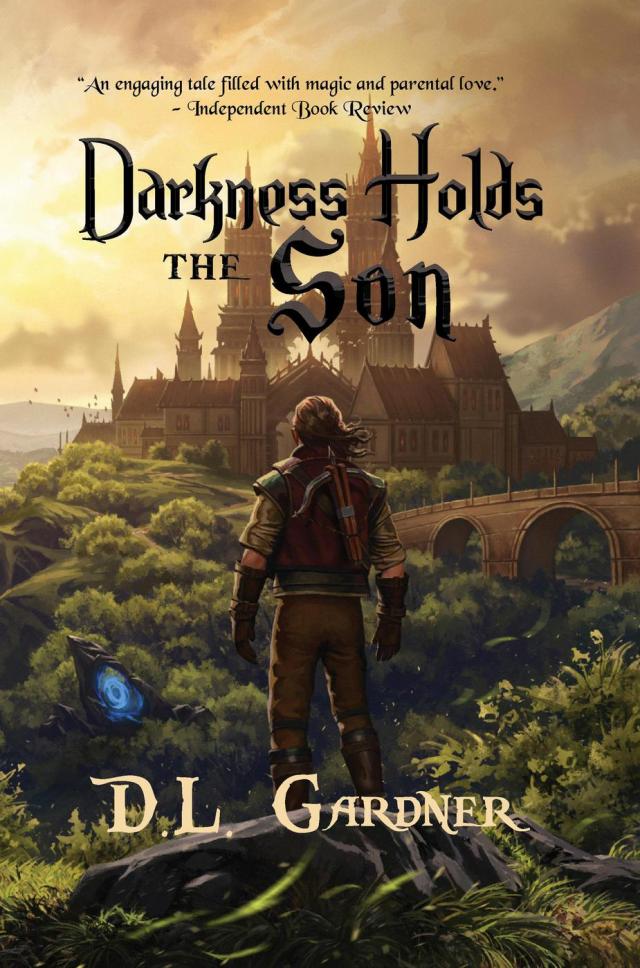


Darkness Holds
the Son
D.L. Gardner
Table of Contents
Title Page
Dedication
Darkness Holds the Son (Sword of Cho Nisi)
The Mercenary
Crispin.
The Militia
Airmed the Healer
Maurice.
Jareth the Prisoner
A King’s Dilemma
A Mercenary’s Plea
The Tuluva Highway
Evanora
Pilgrimage
Anna’s Task
The Market
The Spy
Haunts of a Wizard
Draw the Magic
The Games
A Peasant Woman’s Plea
THE JOURNEY
Jareth’s Release
The Mind of a Conspirator
The Manor’s Dark Passage
The King’s Witness
The Chase
Crispin’s Initiation
The Herdsmen
Attack of the Browncoats
Prisoner
The Blacksmith’s Daughters
The Map
Neal in Wellstone
Rinbard
The Rescue
Rigelstaff
At the Inn
Anna in Rigelstaff
The Troops
The Battle
Epilogue
Sign up for D.L. Gardner's Mailing List
Further Reading: Ian's Realm Saga
Also By D.L. Gardner
About the Author
The book is dedicated to the loving mothers and fathers of this world who keep watch faithfully over their children.
Darkness Holds the Son
Companion novel to Sword of Cho Nisi
This story is the sole work of
D. L. Gardner.
No portion may be copied or used in any form without the consent of the author except for brief review passages.
@ 2022 D. L. Gardner
Information may be obtained by contacting
Dianne L Gardner at gardnersart.com
All characters are fictitious and any resemblance to any place or person is purely coincidental.
More works by the author as well as video and audio are listed on the author’s website. https://gardnersart.com
They left Tuluva and followed the road along the Great Wellstone River, a body of water whose distant shores launched the mightiest empire in the modern world. Casdamia. A land known for its cruel rulers and uncontrolled magic.
Some told tales of an abyss—the Neverworld they called it. They borrowed the term from travelers who referenced mysterious caves and tunnels where sorcery had its roots.
No one in the modern world spoke of sorcery. The country had been rid of such evil ever since the princess of Prasa Potama had destroyed the black wizard in the caves of Mount Ream and his curses had been driven away with the death of the dark wizard, Skotádi. The giants disappeared and the flying beasts had vanished. The once possessed Prince Barin had been healed and crowned king of Potamia. Even the emperor of Casdamia who had been blinded by Skotádi’s magic, regained his eyesight.
Those battles had quickly become legends and stories and ballads spread of King Barin’s sword swallowing the wizard’s magic, a dragon blessing it, and the king locking the weapon away in a dungeon.
But rumors of other supernatural events found their way into pubs and inns across the land—rumors that the governing bodies quietly refuted to avoid panic—rumors of other curses, stolen children, and war.
The Mercenary
JARETH SAT UPRIGHT in his chair, scratched the stubble on his chin, and glanced briefly at his wife and children before he mumbled the evening blessing. “Thanks be to the gods-of-plenty for this meal. Hopefully, it won’t be the last decent spread my family enjoys this winter.”
The fire in the hearth popped, sending shoots of flame up the chimney as if Jareth’s words needed emphasizing. When it died, light in the stone cottage dimmed. Cloaks hanging on a rack by the door melded into the shadows, the spinning wheel near the fireplace shimmered faintly in the flame’s reflected light, and silence resumed.
“Jareth,” Lorica, his wife, said softly, “our goats will sustain us. We will have milk and eggs. We won’t go hungry.”
“Unless the winter is too cold, and the hens stop laying.”
“We’ll make do.”
“We hope.” Jareth shrugged and blew steam off his spoonful of soup. Worry tormented him. This happened whenever he had to leave home. It was true Lorica could barter goat milk, hides, and meat for vegetables that the neighbors grew and for other goods while he was away. If she were careful, the smoked chevron hanging in the root cellar would keep the family fed until he returned. But there were other concerns that wrenched his gut, and these could not be remedied with a full belly and a warm bed.
“Then don’t leave if you’re so worried,” Lorica dished out a ladle of carrots into Kandace’s bowl. The eight-year-old’s lower lip jutted out.
“You know we can’t pay Lord Castille’s new tax with what we have. No one in Tuluva can,” Jareth said.
“We can bring him some of our livestock.”
“We’ve been through this before, Lorica. The baron refuses in-kind for payment. He wants money.”
“We don’t have money,” Kandace blurted. “That’s what Mother says.”
“And your mother is right. That’s why I’m leaving to make some. We don’t earn money goat herding.”
“I wish you wouldn’t make our livelihood sound so distasteful,” Lorica complained. “It’s kept us well, sheltered, and clothed all these years.” Lorica set the cast iron pot back on the coals in the fireplace and took a seat at the table across from him.
Jareth shoved another spoonful in his mouth as an excuse not to argue. His was the only solution. If he didn’t find work that paid well soon, the family would be homeless, enslaved, or in prison.
“Why do we have to pay Ogress’s taxes anyway? Why can’t the city take care of themselves?” Crispin, Jareth’s twelve-year-old son, asked.
Jareth wiped his mouth and swallowed. “Because the mayor of Tuluva is afraid of Lord Castille, and he’s afraid of war. He won’t sign a charter. That would upset the way this village operates. And so, we’re subjects of Ogress—whether we enjoy the benefits or not.”
War was work, and Jareth would happily fight. His skills were in the crossbow, and his passion for combat boiled his blood. He’d be looking for a battle as soon as he set foot on the road out of Tuluva.
Jareth glanced into Lorica’s eyes as she passed the bread to him, but she avoided returning his gaze.
“Father, how long are you going to be gone?”
“Not long,” Jareth answered, setting the bread on his plate, and piercing a chunk of meat with his knife. “Two weeks, perhaps.”
“Now that I’ve learned to use a crossbow, I should go with you,” the boy said with eager eyes.
“You should stay here. Your mother and sister need you.”
Jareth had considered bringing Crispin with him but later shunned the idea. The boy was too young, and Jareth could not risk having the lad on the battlefield, what with his condition.
“You think you’ll find work that quickly? What if you don’t?” Lorica asked. “I can sell our milkers and get enough money to pay the taxes.”
“And then what will we do with no steady income? Half our resources come from those milk goats. No. It would be foolish to sell them just to appease a man whose greed overrides his common sense. I’ll take care of it. There’s been rumor of war in Ogress,” Jareth answered as he chewed. “If I get there soon enough, the baron’s militia will hire me. This is a good stew, Lorica. One of the best you've ever made." He gave his wife a smile, hoping it would warm her attitude toward him. Every time he went off to battle an argument would ensue. She pressured him to be a goatherd, and so when there were no financial worries, he played the part. But he never enjoyed it the way he enjoyed walking away from a good fight knowing his skills had kept him alive.
“I thought you were against the baron,” Crispin commented
“I’m against his taxes, but I have to think of my family first. Fighting is what I do best, and it keeps food on the table. If the baron offers me a wage, how can I refuse?” He waited for Crispin to answer, but the boy only shrugged. “You see, by fighting for the baron, I earn the money to pay his taxes with a measure more to live on. It works out in the end.”
“But the common folk? You'll be fighting against people like us."
"Which is why they need me—to settle the riff quickly so there will be little loss of life. Son, so long as the baron has money to buy an army, the common folk will lose their battles. Unless they have a militia, they should remain quiet.”
“Father, if the war came to Tuluva, would you still fight for the baron?” Kandace asked. "Against our friends?"
“The war will come to Tuluva. It’s just a matter of time. I hope to have our finances in order by then. Perhaps I’ll be rich enough to buy an army for our friends. And then we’ll live freely. All of us will. The entire village!”
“Ogress is at least two days away,” Lorica interrupted.
“I’ll leave in the morning.”
She didn’t respond, but her sigh told him how she felt. His family would suffer in his absence, but they would suffer even more if he did not go.
“Or I could leave tonight.”
“But there’s not.” Jareth leaned forward and studied her. “Lorica, look at me. I’m a crossbowman, not a goatherd. Fighting is the only skill that has ever brought us prosperity. You must give me your blessing. If what I hear is correct, this battle in Ogress will be over shortly, and then we’ll have enough money to pay the baron with some left over for the winter! You understand, don’t you?” he asked.
She gave him barely a nod but a hesitant one. He broke his bread and dipped it in his stew, taking his eyes off his wife and glancing at his daughter Kandace as she played with her food.
“Do you want my carrots, Father?” she asked. “They’ll give you a keen eye and a quick hand for battle.”
Jareth shook his head. “You eat them.”
They finished their supper in silence. Jareth ate hurriedly, for he wanted the night to pass, anxious to be on the road. After sopping his plate clean with his bread, he nodded to his son.
“Crispin, why don’t you get that fire going?”
The boy set his napkin on the table. “Yes, sir.”
Jareth followed him into the common room, leaned against the wall near the hearth, and watched Crispin tend the fire.
“You’re a young man, now,” Jareth whispered. The boy’s sandy curls fell over his shoulders when he blew on the coals. As much as Crispin looked like his father, he had his mother’s dark brows and her deep brown eyes. He was growing up too soon. The thought of Crispin becoming a man left Jareth edgy. The reason for being in this settlement, for goat herding, for homesteading with Lorica, was to raise his family. What would he do when his children were grown? What roots would Jareth claim, then?
“If I’m a young man, why can I not go with you?” Crispin asked, his gaze set on the fire.
“Because your mother needs you.”
Crispin spat in the hearth and warmed his hands. “Mother needs you, as well,” he countered.
“And I need to provide for her. Don’t argue with me. This is the plan—for now. Soon enough you’ll be a warrior and can fight wars. Maybe someday you’ll have the responsibility of paying the lord’s duties. Be grateful you don’t have those worries, yet.”
He wished his son would look him in the eye when they had conversations like this, but Crispin had a stubborn streak.
“You know I love you. I’m proud of you, Son,” Jareth assured him.
Crispin rose and dusted his hands, but when their eyes met, he scowled, and then, wide-eyed, he shuddered. Jareth knew that look, and a cold chill raced up his spine.
“What’s wrong?” Jareth asked, and his heart skipped a beat. “No, not again?”
Crispin’s face paled, and a mist seeped out of his pores. The boy trembled, and his lips quivered. Jareth reached for him, but Crispin recoiled, and for a moment, Jareth could see through his body—as if he were a ghost.
“Don’t tell me it’s begun again, that you’re seeing that spirit again?”
“I told him to leave, Father, but he snuck in last night and has been...talking to me...”
The vapor engulfed Crispin and a shadowy form appeared.
“Get out!” Jareth yelled as another boy’s image took shape in the haze. “Dodge, Crispin!” Jareth drew his dagger and swung at the vapor as Crispin ducked and fell to the ground. With a loud sucking sound, the haze left Crispin’s body. It paused in the form of an adolescent boy, locked eyes with Jareth, then vanished through the walls into the night.
Jareth grabbed his crossbow.
“You all right?” he asked.
“Yes,” Crispin answered. Though ashen and breathless, the boy sat up on his own. Lorica ran from the kitchen and hurried to his side.
“I’ll be back!” Jareth flung open the door.
This was not the first time sorcery had seized his son, but Jareth swore it would be the last. The magic slid down the road like an eel snaking through seaweed. No longer was it the image of a strange boy but appeared as a blue mass fringed by lightning and traveling like the wind. Jareth ran, determined to find its source, and annihilate it.
Avoiding a cluster of homes, the light spun past the fields into the woods, staying on a course that led deep into the forest. Jareth knew this route for it led to the old widow’s shack. The Tuluva residents avoided that homestead, claiming the ruins were haunted by the old woman’s spirit and that it was a gateway to an even more evil place. Some told tales of an abyss—the Neverworld they called it. They borrowed the term from travelers who referenced mysterious caves and tunnels where sorcery had its roots. Jareth hadn’t lived in Tuluva when the widow was alive, and he disregarded such rumors as superstitions, but after his son’s ailment, he was prepared to believe anything.
No moonlight lit his way, and the canopy of the woods grew dense. Had Jareth not been a seasoned soldier skilled at navigating in the dark, he would have stumbled. But his surefootedness kept him moving steadily toward his prey, and soon the remains of a cottage came into view. The front of the structure stood solid, the porch intact, but the roof had partially collapsed under wet and moldy straw, and the back rooms had been burned. Rotten beams leaned precariously under the weight of what thatching remained. The smell of lye from wood ash and mulch lingered, even after years of abandonment.
As though this was its final destination, the magic slithered through the walls of the house and disappeared.
Jareth drew a bolt from his quiver and nocked his bow, stepping cautiously, peering in the window, and seeing nothing. As softly as he trod, the porch boards creaked, frightening a rat that scurried under the steps. Jareth paused and caught his breath, uncertain as to what awaited him inside this hovel. He pushed against the door, and it swung on broken hinges. Starlight illuminated an ornately woven spider web hanging across the threshold. Jareth ducked under it and entered.
No furniture decorated the house, having been pilfered long ago. The rooms were bare aside for dirt mixed with pine needles, tree limbs, and rot from the floorboards. He stepped carefully with wide eyes. Alert. Not a sound came to his ears, but a faint blue shimmer drew his attention to another room. Not the eel-like magic he had chased through the woods, this vapor came from the floor, escaping through a trap door that had been propped open. Jareth drew near, holding both his breath and his crossbow. When he came upon the wooden door rattled by flashes of light and energy, he knelt and peered into the dark chasm. Therein, he eyed his prey making its way through the void.
His heart galloped and cold sweat dripped from his brow. This abyss could be the Neverworld—the dark chasm alluded to in folklore and tall tales. Stories which, up until his son’s affliction, he had refused to believe.
With the crossbow in one hand, he jiggled the wooden rail with the other, assessing the sturdiness of the ladder. Cautiously he placed his foot on the first rung.
“Dare I? For Crispin,” he whispered. With a breath of courage, Jareth descended the stairs. The wood groaned under his weight but the hatch above him remained open. A thick haze hovered over the entry, though, threatening to slam it shut.
Once his feet touched solid ground, and Jareth’s eyes became accustomed to the dark, he moved through the void. His prey had disappeared leaving clouds of putrid mist hovering behind, clinging to the walls. Forms of unidentifiable creatures appeared in those clouds—figures neither living nor dead but somewhere in-between. They mumbled and growled as he passed. With slimy, bony fingers, they reached out, itching to take hold of him, yet their bodies remained adhered to the walls as if some unforeseen force held them back. They cried with mournful voices, some in a language he couldn’t understand, but others spoke words that gave him chills.
“Let us take him,” they begged. To whom was a mystery.
Their vaporous bodies illuminated space around him and even though he was thankful for the light, he ran toward the dark, partly to avoid the creatures, and partly to keep pace with his racing heart. The light diminished as he traveled away from the ghostly chamber. When he came to a curvature in the tunnel he stopped to catch his breath and focus, for his surroundings were now completely black.
“It’s a trap, you know,” someone said. Jareth spun around wide-eyed. As his eyes adjusted to the dark, he deciphered the figure of a man. Jareth raised his bow.