

The plotters, p.1
The Plotters, page 1
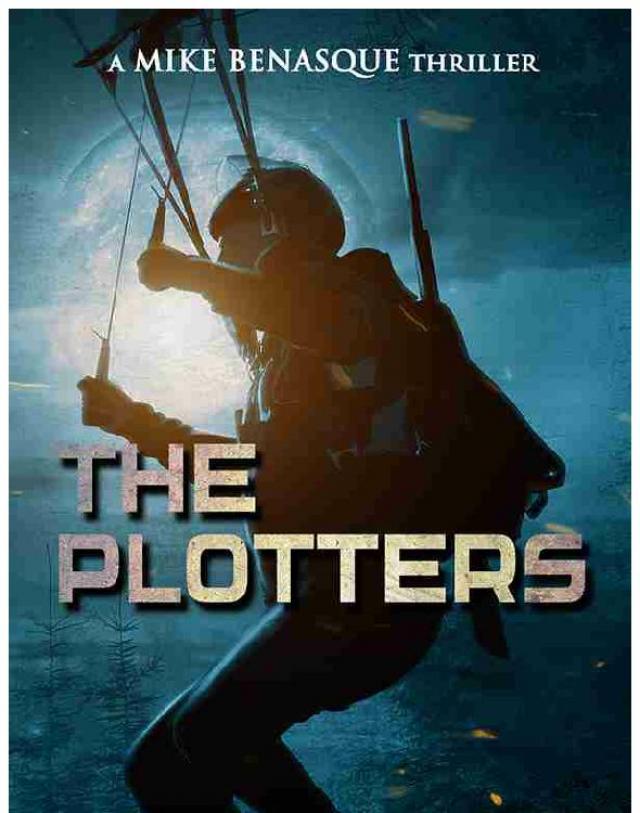


A MIKE BENASQUE THRILLER
THE PLOTTERS
Also from ALAN CAILLOU
CABOT CAIN Series
Assault on Kolchak
Assault on Loveless
Assault on Ming
Assault on Agathon
Assault on Fellawi
Assault on Aimata
Mindanao Pearl
MATTHEW TOBIN Series
Dead Sea Submarine
Terror in Rio
Afghan Assault
Congo War Cry
Death Charge
Swamp War
The Garonsky Missile
MIKE BENASQUE Series
The Plotters
Marseilles
Who’ll Buy My Evil
Diamonds Wild
IAN QUAYLE Series
A League of Hawks
The Swords of God
DEKKER’S DEMONS Series
Suicide Run
Blood Run
The Charge of the Light Brigade
A Journey to Orassia
Rogue's Gambit
Cairo Cabal
Bichu the Jaguar
The Walls of Jolo
Khartoum
Rampage
South of Khartoum
The Prophetess
Mindanao Pearl
A Journey to Orassia
Joshua's People
The Cheetahs
The Hot Sun of Africa
House on Curzon Street
THE PLOTTERS: A MIKE BENASQUE THRILLER
Book One
Copyright 2024 Eagle One Media, Inc.
Original Copyright 1960 Alan Caillou
All Rights Reserved.
No part of this book may be copied or retransmitted without the express written permission of the publisher and copyright holder. Limited use of excerpts may be used for journalistic or review purposes. Any similarities to individuals either living or dead is purely coincidental and unintentional except where fair use laws apply.
For further information visit the Caliber Comics website:
www.calibercomics.com
CHAPTER 1
It’s hard to decide just where all this trouble really started.
I suppose, in truth, it was on that first escapade when I found myself involved in one of those comic revolutions that are always going on down there, giving a hand to a wounded rebel out of nothing more political than a distaste for seeing a man bleed to death on your own front doorstep; or when I came back and wrote those virulent articles that painted me—quite incorrectly, I insist—as a man who might be interested in such things as justice and the human rights of the individual. I say incorrectly, because the truth of the matter is that you can only afford to fight for these abstractions if you have the strength, and the courage, to defend yourself against the massive and inexorable retaliation that is bound to come…and the fear of which sent me into hiding like any common criminal, with not a friend foolhardy enough to raise a finger to help me.
Or perhaps it began when I found myself stranded, out of a job, and broke as usual, in a crummy water-front hotel here in La Guaira, which is the nearest the ocean comes to Caracas. They’d sent me to Caracas, my paper that is, to do a series of tourist articles. You know, the usual guff that any hack journalist can write on a weekend tour of the bars and night clubs, with free drinks if you remember to mention the right places, and some extra money on the side if you’re not too fussy where it comes from. It’s not much of a job, but I’m not much of a journalist either. And they pay all your expenses, once you’re there; though I had to fix my own passage with the skipper of the most dilapidated freighter you ever saw.
Anyway, I reached Caracas in a blinding heat wave that made the sweat run down my chest under my shirt, and after a little while I filed home some stuff I’d written on the boat, because, hell, I used to live in Caracas and I know every tavern, every night club and every tourist trap here. But I went overboard about Digger’s Place, because Digger is an old friend of mine, and—wouldn’t you know it?—my editor had been out there a year back and Digger’s Place was precisely the spot where he’d run into a little trouble and lost his pocketbook. I must admit, with due respect to my friend, that it is a bit of a dump. So I found myself out of a job again, and the cable office wouldn’t even accept my wire asking about the half-fare back home the paper had agreed to pay.
But an enterprising man can always manage to earn enough to keep body and soul together fairly honestly, though I certainly wasn’t making any fortunes. I couldn’t get a permit to look for a proper job—with one of the big oil companies, I thought—but I showed the tourists around and bought souvenirs for them, and fixed them up with dates, that sort of thing. I did some Spanish-English translations and lived off my old friends when times were hard, and before I knew it a year had gone by and I was still living from hand to mouth and wondering where the next week’s expenses were coming from. But it’s like that all over South America. Lassitude, laissez faire, tomorrow-will-take-care-of-itself, call it what you like.
All the same, it was tough, and, when I found this fellow following me, there hadn’t been any food in the house for the last two days.
Food? Hell, there hadn’t even been any gin.
◆◆◆
I was talking business with a tourist who wanted to see the sights, and we were sitting at a table in one of those rather drab little bars down on the Calle Caluso, where a tall thin girl from one of the islands was slowly peeling off her clothes to the halfhearted accompaniment of the worst band on the continent. Her long limbs glistened with oil, or sweat, and they were richly brown and well-muscled, but she was quite a beginner at the game. My tourist was watching her avidly, and probably thinking about his wife. If he had one.
I got up and went over to the band, and told the drummer to send the girl over to our table when she was through, and then I stood at the door for a moment, smoking a cigarette and sucking in the cool night air. A neatly dressed man in a silk suit was strolling along the alley that led to the bar, attracted by the garish red neon sign that was flashing over the door. It’s a funny thing: a red neon sign on a main street doesn’t mean a thing; but put it halfway down a dark alley and everybody wants to see what goes on there.
He was a very dignified sort of man. Distingué, I suppose, is the word. His hair was thick and well-groomed, a little bit gray, and he had a small gray mustache. It occurred to me, then, that I’d seen him once or twice before lately, always sitting close by where I happened to be, and there was a sudden unaccountable feeling that something was wrong…Perhaps it was because he looked a bit out of place in this grubby quarter—not with the out-of-placeness of the tourist who is excitedly slumming (and dressed in his oldest clothes, just in case) but somehow too nonchalantly sure of himself. It’s funny how you get a feeling about these things. I owed quite a lot of money all over the town, and some of the collection agencies are not very fussy about the way they gather in their clients’ delinquent accounts. This was the first thing that came to my mind; I suppose it was the air of efficient ruthlessness that he seemed to have. Or perhaps it was just my guilty conscience.
He stopped close by me and looked at the nudes that were pasted up in a glass case on the red brick wall, and I turned away and began to move inside. He looked at me then and smiled quickly.
He said, pleasantly enough: “I’ll be at your apartment at midnight. It’s important to you.”
He was sauntering off again before I could recover from my surprise. I just had time to see that the alleyway was deserted, and then I went hastily back to my tourist to get away from what I was sure was a nasty thought…
You see, Caracas is full of all kinds of rackets, some mild and only semi-legal, and some quite violent and lucrative, and there aren’t so many people like myself, unemployed and with what you might call an international background, who can be called upon for the odd jobs that turn up from time to time and which are too risky for the known characters to handle.
A long time ago I had realized that sooner or later I would be faced with the problem of joining one of the rackets. People like me were too much in demand there. I knew that I would be approached by one of the mobs that handle the narcotics, or the gun-running, or the brothels, or the smuggling… And I knew that I would have to make up my mind about it pretty carefully. I couldn’t afford to keep on living off what I could scrounge from the tourists, and yet I’m not—how shall I put it? Tough enough? Dispassionate enough? At any rate, these ventures were big-scale and pretty deadly, run by some high-caliber mugs of the old kind who’d found that Venezuela was a profitable place to operate from. It’s not that I have too many moral qualms, of course, nothing like that at all. It’s simply that I was scared to get mixed up with one of the crowds whom I knew to be powerful, well-organized and quite vicious. So far, I hadn’t been afraid of every passing uniform, and I rather wanted to keep it that way, hoping from day to day that something would turn up.
So, by and large, the instruction from the distinguished-looking man in the silk suit had me excited and deeply disturbed. And “instruction” is the right word. There was something in his manner, affable though it was, that said quite clearly: And you’d better be there, too.
Well, there was no use worrying about it. I went back to the table. My tourist was giggling with the long-limbed girl who’d been dancing, leaning forward with his hand on her shoulder and breathing fumes of raw whiskey over the poor thing. The waiter was already bringing them some pink champagne, and a tall glass of cold tea and soda for me, and when I sipped it I saw that he had slipped a slug of rum in it, which was his way of sympathizing with me.
I was pleased about the champagne. There was a fat commission on it, and I must say that this fellow really wanted to spread himself around. His name was Vallance, and he was an insurance broker from Iowa, I think, a nice enough guy really, but a bit of a visiting fireman if you know what I mean. He was getting pretty drunk by now, and looking at my watch I began to wonder if I could get rid of him in time for my meeting at twelve o’clock. At that time of night things are only just beginning to look up in Caracas. It wouldn’t have been wise merely to dump him, because in the state he was in someone would surely filch his pocketbook, and, after all, I had a certain responsibility to him.
At a quarter to twelve, I said to the girl, in rapid Spanish: “I’ve got a job to do. You want to take him over to your place now? I’ll meet up with you afterward.”
She nodded her head, but Vallance got up suddenly and said: “What a dump. Let’s get out of here.”
I was worried that perhaps he had understood what I was saying, but he added: “Gotta get some air. What about that place round behind...round behind the hotel?”
I said: “You’re the boss. Wherever you want to go...”
He put a pile of notes on the table, and I just had time to check how much was there, I don’t think the waiter would have welshed on me, but it’s as well to make sure. At least, when you need the next month’s rent it is. If we walked, we’d have to pass my apartment, and I thought perhaps I could park him for a while at Digger’s Place, which was quite close by. I said: “You want to walk? It’s not too far...”
“Sure. Do me good. Get rid of some of this...”
He patted his paunch affectionately and stood looking at the girl for a moment. He said to her at last: “Maybe...maybe we’ll be back later on, eh?”
So we went out into the cool fresh air, with the breeze coming up off the water, and we turned toward the hotel, but, as we were passing my place, he stopped and looked quickly over his shoulder at the deserted street, stood there swaying slightly while a fisherman passed us on a bicycle, and then said quickly: “All right, my friend, up you go. I’m in on this meeting of yours.”
You could have knocked me over with a banana. I stood staring at him for a moment, with my mouth hanging open foolishly, conscious that he wasn’t the least bit drunk any more but was standing firm on his widely spaced tubby legs, gently urging me toward the stairway. He said, smiling cheerfully: “Well, let’s not hang around where everyone can see us.”
It wasn’t any use objecting, so I didn’t. We went up to my apartment and the door opened, and the distinguished fellow in the silk suit was standing there, perfectly at home and at ease in my room, and we went in and shut the door quickly, and for a moment we stood there like guests at a party who don’t know anybody and haven’t yet spotted the bar. Except that my heart was in my mouth.
Then my tourist, Vallance, said cheerfully: “You’ve half met Mr. DeBries, haven’t you? And my name is Vallance, as you know.”
DeBries, the man who’d told me that what he had to say was important to me, held out his hand and I took it as though the circumstances of our meeting had been perfectly ordinary and normal.
Speaking to him, Vallance said briefly: “The people next door?”
DeBries nodded. “Nobody home,” he said. “The walls are thin, but we can talk quietly.” He turned away, then, and sat down on the sofa.
He was a tall man, with a face that I suppose you would call good. Intelligent eyes, an air of authority, a rather high-bridged nose that made him look faintly supercilious...there was the trace of an accent in his voice, not easily identifiable; it was more of an intonation, really.
Vallance, who had seemed incapably drunk a moment ago, was a short, fat man, going bald, with rather flabby features and an imposing paunch. He ran a hand through what was left of his hair and went to the mirror over the bookshelf, straightening himself out a little. He said apologetically: “I’ve had rather more to drink than I intended...”
His voice was quite steady, and, when he turned from the mirror and looked at me, he was smiling with a kind of secret amusement.
I thought it was time to establish my tenancy there. I said, as frigidly as I could manage: “May I offer you gentlemen a drink?”
DeBries waved a negligent hand and said: “Mr. Benasque, we will get down to business. First of all, let me apologize for the melodramatics, the secrecy and, of course, the intrusion. But when you’ve heard what I have to say, you will agree that a certain amount of care is necessary. We have a proposition to make to you, which may well interest you...for a variety of reasons. If it does not interest you, then I must have your word that what I say will be treated with as much confidence as you think it deserves. Is that agreed?”
I said: “That’s a pretty liberal suggestion.”
Vallance broke in. “Precisely. If you think it does not deserve any confidence at all, then no great harm will have been done. If, on the other hand, you are interested...”
He left it hanging. I poured myself a drink and waited.
DeBries went on with the air of a man who chooses his words carefully and does not waste them. “First of all, Mr. Benasque, we know all about you and you know nothing about us. All you need to know at this stage is that we represent a group of interested people. We are positively not employed by any government or government agency, although we do have...a measure of government support. Is that clear? What we are doing is not illegal—at any rate, it is not illegal here. You can put us down as...as supporters of a cause, and leave it at that. We believe that what we are doing is right...and we think that this is the general view. On the other hand, elsewhere it is illegal, and everywhere, it is dangerous. Do I make myself clear?”
I was waiting for the pitch. I said: “Not particularly. But I’m listening.”
“All right. Now.”
He was sitting there, DeBries, with a faintly professorial air, rather like a kindly lecturer in a university, with the tips of his fingers gently stroking his long chin. He went on: “Some years ago, you wrote some articles, three of them, about a man called Lazlo, José Lazlo. Do you remember what you said about him?”
“I remember.”
“If you do not, then I have copies of those articles here.”
He took a long envelope out of his breast pocket. I said again: “I remember all about Lazlo. Poor devil.”
“Poor devil? Why do you say that?”
“He found it didn’t pay to fight oppression. So he joined it. I always feel sorry for a guy who has to throw his principles overboard like that. Not many of us left.”
“Oh? Have you thrown yours overboard too, Mr. Benasque?”
“They began to swamp the boat.”
“And now?”
“Now I’m more interested in the prosaic things. Like eating.”
Vallance broke in again. I noticed that he was always ready to speak when there was a bit of a pause. He said abruptly: “If there were another war, the hypothetical question, would you go back to the army?”
I shrugged my shoulders.
“I suppose so. Probably the safest place to be.”
“And would you go back to the outfit you were with the last time?”
I could feel an uneasiness creeping over me. The reference to my wartime efforts was far too casual to be pleasant. As far as I’m concerned, the war was over a long time ago, and I have not the slightest intention of getting mixed up again with the mob I ran around with then. I said carefully: “I think they’ll need a new crop of talent, in my field, don’t you? We had good cover in those days, but now...Now, they know all about us. I’d probably do public relations for the army instead. A lot safer.”
DeBries said: “Forgive me, Mr. Benasque, but I do not believe that whatever sense of patriotism you used to have...in the old days...is quite extinguished.”
“Nowadays, I call it chauvinism. I’m an internationalist.”
“You can afford to be cosmopolitan and still abhor what goes on across the other side of the fence. Of the various fences,” he said.
“And you can disapprove without rattling a saber over it. The neighbor has a right to his own ideas. You may not like them particularly—”






