

Master orion, p.1
Master of Orion, page 1
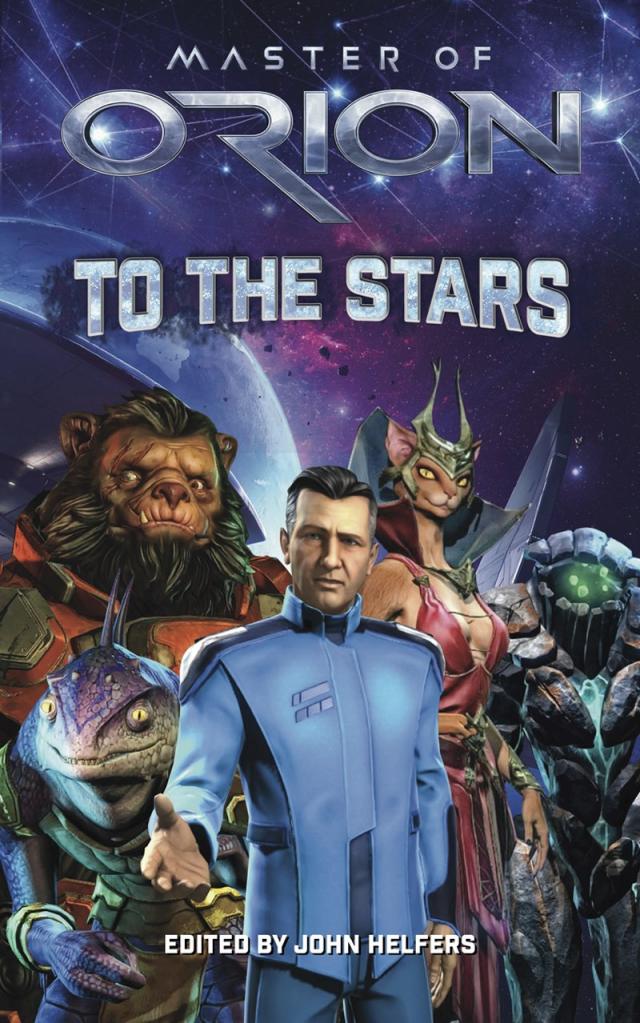


Master of Orion: To the Stars
Jennifer Brozek
Michael Buonagurio
Kaitlyn Curlee
Dayle A. Dermatis
Kelsey Howard
Jane Lindskold
Steven Mohan, Jr.
Jody Lynn Nye
Christopher Parker
Jean Rabe
Aaron Rosenberg
Michael A. Stackpole
Lee Stephen
Robert E. Vardeman
Phaedra Weldon
Edited by
John Helfers
Contents
Foreword
Introduction
Acknowledgments
Prologue: Icarus
Devouring Cloud
Keeper of Memories
Shifting Focus
Take Your Daughter To Work Day
The Celadon Web
The Tarika Runner
The Silence of Coventry Shrine
The Craft
The Best Laid Plans
No Matter What Species
The Greatest Jewels Of All
The Survey Team
The Cost of Water
Inconceivable
A Duel in the Desert
Foreword
Master of Orion is one of those video games that has stood the test of time since its initial release in 1993. This was the game that brought 4X (eXplore, eXpand, eXploit, and eXterminate) to the gaming world when Alan Emrich first summarized this concept of gameplay. More than a simple “conquer the galaxy” game, MoO had players make sometimes agonizing decisions over their colonies, diplomatic efforts, planetary production, etc.
Players became engrossed for countless hours attempting to lead their empire to victory—so many hours that apocryphal tales of failed classes, broken relationships, and multiple days of no sleep were jokingly stated. The franchise is still considered the standard by which follow-on 4X games are often compared to. However, no greater compliment can be made to a video game then the fact that over the intervening years players, both veterans and novices, continued to play MoO.
When the opportunity arose in 2013 to acquire the rights to the franchise, it became a priority to make the game part of the Wargaming.net family. Our CEO, Victor Kislyi, wanted to bring MoO back for the next generation of players who had never experienced the original. The greenlight was then given to bring an updated, yet still true to its core, version of Master of Orion to the gaming community.
In an ironic twist, the studio selected to produce this reimagined edition was the Wargaming.net Austin, Texas studio—located on the same road where MoO was initially developed. One major difference from the beginning was the decision to flesh out the universe, and particularly the races, to bring additional depth and direction to the game.
My team and I were handed the task of this “deep dive” into breathing life into this beloved game. Over the ensuing two years, what started out as cryptic notes scribbled on paper became hundreds of pages of racial history and culture, art depicting unique home planets and technologies, countless meetings to help tweak the graphics and overall story, and thousands of additional requests to aid in development.
For myself and my team, the highest compliment came near the end when the voice actors were brought in. They were each given the background for their race: culture, military, religion, attitudes, prejudices, and even some secrets to aid them in portraying each creature as a unique entity versus a “cookie cutter” motif. To a person, they stated that the material presented helped them to slip into each character very quickly.
Wanting to share some of this wealth of background, Wargaming Austin began to release short stories highlighting aspects of each race to the fan community. These stories were met with excitement and praise from the players, to the point that when we stopped producing them, a clamor went up for more. We received requests to explain ICARUS, would there be more on Natesa Nori and the Tarika Runner, how devious really are the buffoon-like Gnolam, and countless other questions.
To give the community who play the game a deeper understanding of their favorite (and not so favorite) races. For the fans of science fiction in general, we hope this provides a gateway to a new universe of enjoyment whether you decide to try the video game or not. For us here at Wargaming.net, we are proud and thrilled to be able to give you a better glimpse into living galactic civilizations that will not be archived with only a select few knowing the breadth and depth to be offered.
Catalyst Game Labs recognized the potential for carrying these tales forward. Partnering with Wargaming.net, we are excited to present these stories by a myriad of well-known as well as up and coming authors. Included within this volume are also some of the more popular short stories from the Wargaming.net vaults, updated and edited for this anthology.
We thank you—the MoO community specifically, and the science fiction community in general—for your support over the years. In keeping a beloved game alive for 25 years, not only on your screens but in fan fiction, fan art, and the mods that allowed Master of Orion to remain fresh but mysterious for all these years.
Enjoy these stories, discover some of the secrets behind the races, and the places in the galaxy. We hope you become enthralled with our universe from Master of Orion: Conquer the Stars!
—Michael Buonagurio
IP Development Manager
Wargaming.net
Introduction
Over the years, I’ve played my fair share of video games. At the risk of dating myself, I cut my teeth on the original Elite game in the mid-80s, with its (at the time) cutting edge wireframe graphics and that damned rotating Coriolus station that took out more than one Cobra Mark III after a successful run.
With that experience under my belt, one would think I’d have been a natural for the original Master of Orion game, which first came out way back in 1993. And yet, alas, for some reason, I somehow passed it by. Oh, the untold hours of space trading and conquest I missed out on!
So, when I was informed that Catalyst Game Labs had acquired the game and fiction license for MoO, I had a moment of not-quite déjà vu, more like, “Where have I heard that title before?” Well, two sequels later, the good folks at Wargaming.net have brought out an impressive new version of Master of Orion, featuring all the bells and whistles that the latest computers can utilize for a richer gaming experience. And the latest iteration of MoO is impressive, featuring A-list voice actors and an amazing interface that makes it even easier to carve your human (or one of a dozen alien races) empire out from the stars. And in the end, that’s what MoO is all about: exploring (the universe), expanding (your hold on it), exploiting (your conquered planets), and exterminating (your enemies). All of which this version has in spades. But there’s also something else there: a rich space operatic universe practically begging to be explored in more detail, a detail that can sometimes be difficult to reach in games. And that’s where Catalyst enters the picture.
Having produced all of the recent new fiction for the BattleTech and Shadowrun IPs, we were a natural fit to work with Wargaming.net on a line of fiction based in the MoO universe. The book you’re reading right now is the first part of that series, with full-length novels coming soon by some of the best science fiction writers working today, most of whom are fans of the game as well. That’s the very best combination, as someone already familiar with the game has an advantage over someone entering the universe for the first time.
Our final line-up is an impressive roster of talent, and their stories run the gamut of science fiction, from straight-up adventure to hard-nosed galactic intrigue to pure space opera.
Long time stalwart Robert E. Vardeman is back doing what he does best, writing rollicking space opera about a crew hired for what they thought was going to be a simple privateering job, but turns into something far more dangerous. Jean Rabe explores alien races on a more alien planet; when two different spacefaring species fight over a world rich in rare minerals, everyone suffers…including knowledge. Michael A. Stackpole serves up a tale of politics, back-room deals, and dangerous intrigue, where words are weapons and the wrong one can do worse than end your career—it can end your life. Dayle M. Dermatis brings us the story of a woman who will go to any lengths to pull off a daring rescue—even hire one of the most mysterious races in the universe to help her. Jody Lynn Nye tells a story of a merchant ship’s crew, attacked by pirates and disabled in space, who are saved by the actions of one crewmember with a distinctly different outlook on life. And Steven Mohan, Jr. rounds out our volume with a gripping story of ship-to-ship combat where a warrior on each side couldn’t be any more different—and yet by the end of their battle, they find that they share unusual common ground.
Sixteen original stories, each one exploring a different facet of the Master of Orion universe. So jump into your frigate and prepare to take off into these tales of adventure among the stars.
—John Helfers
Catalyst Game Labs Fiction Director
July 2018
To the original creators of Master of Orion for creating a video game that lives on 25 years later: Marie Barcia, Steve Barcia, Ken Burd, Jeff Dee, David Govett. Jeff Johannigman, George Edward Purdy, Frank Vivirito, and Bill Willingham.
* * *
Most especially to the fans, young and old, who have played untold hours of enjoyment exploring and dominating the galaxy!
Acknowledgments
This volume could not have been produced without the tireless efforts of Michael Buonagurio, Christopher Parker, and Kaitlyn Curlee.
Prologue: Icarus
KELSEY HOWARD, CHRISTOPHER PARKER, AND KAITLYN CURLEE
Mara held her clearance badge in her upper right hand. She showed the card to the armed guards, then pushed it into the security scanner. The thick metal doors slid open, releasing a gust of cool air. She took a deep breath and strode inside, trying to appear at ease, but her heart was pounding in her chest.
Her presence in the deepest and most secure level of the Controller’s Library required direct approval from the Controller of the Quanta, leader of the entire Psilon Empire. She had been nominated to join a top-secret research committee by the director of the scientific advisory board just the week before. Mara had accepted the opportunity on the spot, though she was still feeling a little stunned.
She entered a vast room lined with dozens of dimly illuminated monitors placed along the walls. These search consoles—the only way to access the enormous archives—filled the room with a purplish glow. At the moment, none of the monitors were being used. A few elderly Psilons milled by them, silent and pale as ghosts, absorbed in other work.
Mara skirted around them to approach the central desk, where a Librarian was waiting patiently for her.
“Call number?” the Librarian asked. Her voice was faint and scratchy, as if she hadn’t spoken for quite some time.
Mara handed her the encoded card she had been issued back at Headquarters. The sequence ALPHAICARUS File 0012 was printed across it. The Librarian looked at it, then down to wake her dark-screened terminal and dashed off a series of commands. A robot not much bigger than Mara’s hand rolled neatly out from under the Librarian’s desk and out of the room, disappearing around the corner of a long hallway on the right.
The highly classified information she was requesting was the last intact account of the mission that had discovered the alien device known as the Intergalactic Communication Resolution System, or ICARUS. It had already been an ancient technology when scientists had first encountered it hundreds of years ago. Now, it was so ingrained in modern civilization that most inhabitants of the galaxy—if they gave it any thought at all—regarded it as an inherent attribute of the universe, no different from gravity or time.
The ‘magic’ of a universal translator that passed seamlessly across electromagnetic fields, infiltrating and changing both electronic networks and the neuron pathways of biologicals, may have taken an air of normality over time, but the mystery of this technology still haunted the Psilons. Despite their zealous attempts to understand it, they couldn’t explain why or how ICARUS was constantly, and in real time, translating hundreds upon hundreds of languages across the universe. Centuries of research had yielded no new information. Teams of scientists had come and gone, some devoting their entire careers to studying the translator, yet nothing more was known about it than the day it was found. More scientists came and went but over time, fewer and fewer continued trying to discern how it operated. Discussion of ICARUS’s inner workings was gradually exiled to the realm of rumors and gossip between eccentric scholars.
Mara had heard the rumors herself, the far-fetched theories and wilder guesses, though she kept her head down and focused on her work—which was always lauded for its brilliance. When asked, she stated that she had no theories on ICARUS, as she lacked access to the collected data. Her non-position regarding one of the most frustrating and longest-running Psilon research failures had proven wise in the long run. Perhaps as much as her dedication, work ethic, intelligence, and prudence, it was her silence concerning the mysterious device that had earned her a place on the ICARUS Research Team.
With a metallic whir, the robot rolled back around the corner with a small box in its cargo tray. The Librarian carefully took the box and opened it; packaged securely inside was an antique audio device and some physical files. She passed the box to Mara, handling it as though it might combust, and then ushered her to a secure room. Mara stepped inside, and felt the door seal behind her with a pneumatic hiss.
Mara went to the single table and chair in the room and put the box down. She unpacked the audio device and the file she was looking for, one that had bold lettering stamped on it:
WARNING: HIGHLY CLASSIFIED.
INDIVIDUALS MUST HAVE QUASAR LEVEL CLEARANCE TO PROCEED.
Slipping the file from its protective casing, she placed it in the accompanying device, anxious for the boilerplate precautions that would precede the actual content to play and be done. Mara fumbled for the audio device’s volume controls as an authoritative voice began speaking softly.
“—empire standards of protecting intellectual property. The following is a direct recording of the deposition of Erga, leader of the team that discovered the ICARUS device. The following information is classified QUASAR, and is not approved for reproduction or distribution by any means.”
A silent moment passed, and then the audio file clicked to life with the sound of steady breathing. The audio was so clear that Mara felt like someone else were in the room with her. The secure room was warmer than the rest of the Library, but she still tried—and failed—to repress a shiver.
A low, detached voice spoke over the breathing. “This is the debriefing of Erga, lead field researcher of the Ampere Salvage Team.” There was a pause and shuffling of papers. “Now, Erga, recount the precise details of the ICARUS device’s recovery. Begin with the planetary landing.” Erga cleared his throat, the sound making Mara jump. “When we first landed on the planet,” he said, “it appeared to be completely barren—devoid of any life or technology. Scouts had reported distant sightings of a suspicious isolated building. In conformity with standard procedure for research operations in lawless or contested systems, we had some hired mercenaries with us—mostly Sakkra, but a few Humans and Mrrshan as well.”
His voice was clear and confident. His logical, even-tempered tone marked him unmistakably as a Psilon, despite the recording’s age. “We entered the structure without difficulty. It seemed to be a minor ruin, much like the ones we had discovered on other planets, and we hoped to find more traces of what we theorized to have been an ancient, galaxy-spanning civilization. However, based on our initial assessment, this particular installation contained nothing of significance. It seemed that someone had cleared the place of anything valuable long ago. Then we found an entrance to a subterranean level. It appeared to be untouched, apparently undiscovered by looters. The research team was naturally eager. The mercenaries were…reluctant. Apparently, they found the ruins discomforting. We threatened to withhold their pay, however, and they eventually complied.”
Erga paused; the recording equipment caught his breathing, deep and steady. He spoke again: “Upon entering the subterranean portion of the facility, we found a set of sealed heavy blast doors. Scanners suggested that there was a large room behind them, but it was heavily shielded. Our scanners could not penetrate to the interior, so we had the Sakkra begin setting explosive charges.”
There was another pause. This time the interviewer prompted Erga by asking, “Is that when the technology began to work?”
“No,” Erga said. “We blew the doors open and gained entry to a massive room. It was empty except for a glowing node in the center. We enacted standard isolation protocols for unknown tech, but when we radioed the mercenary team patrolling outside the facility…we noticed that the node was demonstrating some kind of activity.”






